Everything you need to know about decentralized AI: how it works, why it matters, key projects, challenges, and what the future holds for decentralized artificial intelligence.
Contents
What Is Decentralized AI? The Complete Guide
Decentralized AI is the most significant architectural shift in artificial intelligence since the transformer revolution. Instead of concentrating AI development, training, and deployment inside a handful of corporations, decentralized artificial intelligence distributes these capabilities across networks of independent participants — coordinated by blockchain, governed by communities, and incentivized through tokens.
If you've been following the AI space, you've noticed a tension. The technology that promises to democratize knowledge and augment human capability is controlled by fewer and fewer organizations. OpenAI, Google, Meta, and Anthropic dominate model development. Cloud providers control the compute. Data brokers control the datasets. The result is an AI ecosystem that's powerful but concentrated — and that concentration carries real risks.
Decentralized AI is the counter-movement. And in 2026, it's no longer theoretical.
This guide covers everything: what decentralized AI actually means, why it matters, how the technology works under the hood, which projects are leading the charge, what challenges remain, and where this space is heading. Whether you're a builder, investor, researcher, or simply someone trying to understand the next era of AI, this is your comprehensive reference.
What Exactly Is Decentralized AI?
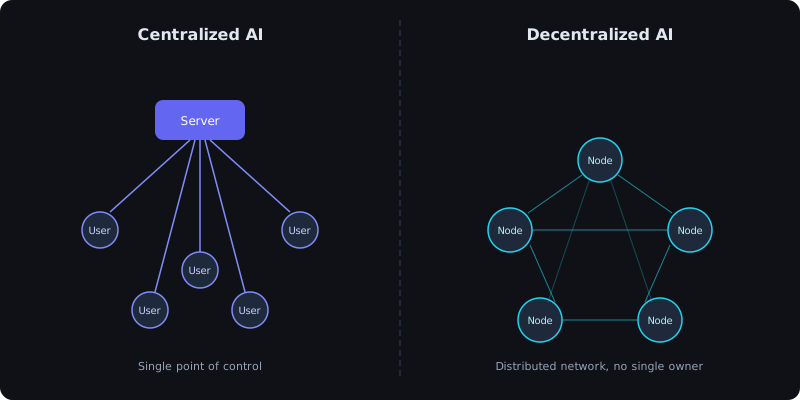
At its core, decentralized AI refers to artificial intelligence systems where no single entity controls the entire pipeline — from data collection and model training to inference and governance. Instead, these functions are distributed across a network of participants who collaborate through shared protocols.
Think of it through an analogy. Traditional AI is like a private library. One institution owns all the books, decides who gets a library card, and sets the rules for what you can read. Decentralized AI is more like the internet itself — a network of connected nodes where knowledge flows freely, participants contribute and consume resources, and no single gatekeeper can shut it all down.
In practice, decentralized AI encompasses several related concepts:
- Distributed training — AI models trained across multiple machines and organizations, with no single party holding all the training data
- Decentralized inference — AI model queries served by networks of independent compute providers rather than centralized API endpoints
- On-chain coordination — Blockchain-based systems that manage payments, verify computations, and govern how AI networks operate
- Community governance — Token-based decision-making about model development, data policies, and protocol upgrades
- Data sovereignty — Individuals and organizations retaining ownership and control of their data while still contributing to AI training
The key distinction from traditional AI isn't just technical — it's philosophical. Centralized AI asks: "How can we build the most powerful model?" Decentralized AI asks: "How can we build powerful models that no single entity controls?"
Why Decentralized AI Matters
The case for decentralized artificial intelligence isn't abstract. It addresses concrete problems that are already creating friction in the AI ecosystem.
The Concentration Problem
As of 2026, training a frontier AI model costs tens of millions to hundreds of millions of dollars. The compute requirements are staggering — tens of thousands of GPUs running for months. The data requirements are equally massive. This means that only a handful of well-capitalized organizations can build the most capable models.
This concentration creates several risks:
- Single points of failure — If a major AI provider experiences downtime, crashes, or decides to change their API terms, thousands of businesses are affected overnight
- Censorship and bias — Centralized model providers make unilateral decisions about what their models will and won't do, what content they filter, and what perspectives they amplify
- Data exploitation — Users' data flows into centralized systems with limited transparency about how it's used for training future models
- Innovation bottlenecks — When a few companies control the frontier, independent researchers and smaller companies struggle to compete or even replicate results
Access and Equity
Not everyone has equal access to AI capabilities. Geographic restrictions, pricing tiers, regulatory barriers, and platform policies create a fragmented landscape where AI access depends heavily on where you are and who you work for.
Decentralized AI networks, by design, are permissionless. Anyone can contribute compute, provide data, or access models. This doesn't solve every equity problem, but it removes the gatekeepers — and that's a meaningful step.
Trust and Verification
Here's a question that rarely gets asked but should be: when you call an AI API, how do you know what model you're actually running? How do you verify the model hasn't been modified, that your data isn't being logged, or that the advertised performance benchmarks are accurate?
With centralized AI, you can't. You trust the provider. With decentralized AI built on blockchain, every claim can be verified. Model weights are committed on-chain, performance benchmarks are validated by independent parties, and data handling policies are enforced by smart contracts rather than terms of service.
This is where blockchain and AI integration becomes genuinely powerful — not as a buzzword, but as an architectural solution to the trust problem.
How Decentralized AI Works: The Technical Foundation
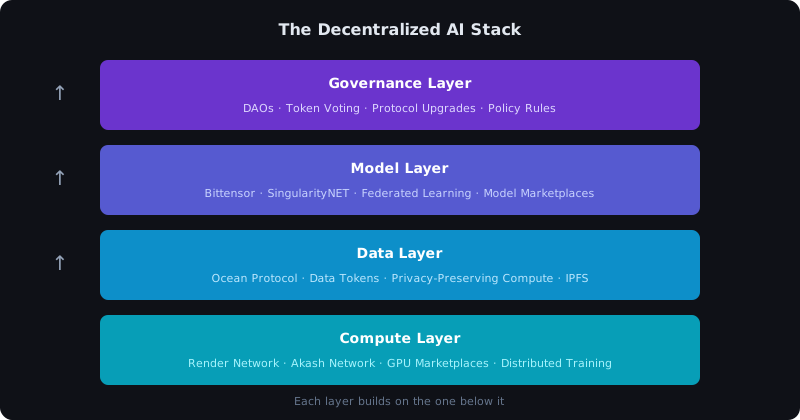
Understanding the mechanics helps separate real innovation from marketing. Decentralized AI systems typically involve four interconnected layers.
Layer 1: Decentralized Compute
AI workloads — both training and inference — require significant computational resources. Decentralized compute networks aggregate GPU capacity from independent providers worldwide.
How it works:
- Compute providers register their hardware (GPUs, TPUs, specialized AI chips) on the network
- They stake tokens as collateral, which can be slashed if they provide incorrect results or go offline
- When a user submits a job (training run, inference request), the network matches it with suitable providers
- Cryptographic verification ensures the computation was performed correctly
- Payment is handled automatically through smart contracts
Projects like Akash Network and Render Network have built production-grade decentralized compute marketplaces. Akash focuses on general-purpose cloud computing with strong AI/ML support, while Render specializes in GPU rendering and has expanded into AI inference workloads.
The economics are compelling: decentralized compute can be 50-85% cheaper than equivalent resources from AWS, Google Cloud, or Azure, because providers are often monetizing otherwise idle GPU capacity.
Layer 2: Decentralized Data
AI models are only as good as their training data. Decentralized data networks address two critical challenges: accessing diverse, high-quality datasets and respecting data privacy.
Key approaches:
- Federated learning — Models are trained locally on each participant's data. Only model updates (gradients) are shared, not raw data. Blockchain coordinates the training rounds and aggregates updates. For a deep dive on how zero-knowledge proofs enable privacy-preserving machine learning, see our dedicated article.
- Data marketplaces — Platforms where data owners list datasets with on-chain access controls. Buyers pay with tokens, and smart contracts enforce usage rights (e.g., "training only, no redistribution, expires in 12 months").
- Data DAOs — Community-governed organizations that collectively manage and monetize shared datasets, with token holders voting on access policies and revenue distribution.
Ocean Protocol pioneered much of this space, providing tools for data tokenization (representing data access rights as blockchain tokens) and Compute-to-Data technology that allows AI models to be trained on private data without the data ever leaving the owner's infrastructure.
Layer 3: Decentralized Model Networks
This is where the AI actually lives. Decentralized model networks coordinate how models are trained, served, and improved across distributed participants.
The mechanics:
- Models are registered on-chain with metadata: architecture, training data provenance, benchmark results, licensing terms
- Inference requests are routed to the best-performing model providers based on quality, latency, and cost
- Validators continuously evaluate model outputs to ensure quality doesn't degrade
- Token incentives reward model operators for providing high-quality, reliable service
Bittensor is the most prominent example. Its network of 52+ specialized subnets covers everything from text generation and image recognition to financial modeling and protein folding. Miners compete to provide the best outputs, validators score quality, and the TAO token coordinates incentives across the entire ecosystem.
SingularityNET takes a different approach — functioning as a marketplace where AI developers publish services that can be discovered, combined, and paid for through the AGIX token. Its architecture emphasizes composability: developers can chain multiple AI services together to create complex pipelines.
Layer 4: Governance and Coordination
The governance layer determines how decentralized AI networks evolve. Who decides which models are included? How are disputes resolved? What happens when the protocol needs upgrading?
Most decentralized AI projects use some form of token-based governance:
- Token holders vote on proposals (model additions, parameter changes, fee structures)
- Staking mechanisms ensure that voters have economic skin in the game
- AI agents can assist governance by analyzing proposals, modeling outcomes, and increasing participation
- On-chain treasuries fund development, grants, and ecosystem growth
This governance layer is what truly distinguishes decentralized AI from simply "distributed computing." It's not just about spreading computation across machines — it's about distributing decision-making power across stakeholders.
Key Projects Leading the Decentralized AI Movement
The decentralized AI ecosystem has matured significantly. Here are the projects with the most traction and technical substance.
Bittensor (TAO)
The most ambitious attempt at building a decentralized intelligence network. Bittensor's subnet architecture allows specialized AI models to compete within domains, with cross-subnet communication enabling complex AI tasks. Over 2 million daily inference requests and growing.
SingularityNET (AGIX)
Founded by AI researcher Ben Goertzel, SingularityNET is building toward artificial general intelligence (AGI) through a decentralized marketplace of AI services. Its recent partnership ecosystem and the spin-off projects (SingularityDAO, NuNet, HyperCycle) create a broader decentralized AI stack.
Ocean Protocol (OCEAN)
The leading decentralized data marketplace. Ocean's Compute-to-Data feature is a game-changer for privacy-preserving AI — enabling model training on sensitive datasets without exposing the underlying data. Critical infrastructure for any decentralized AI ecosystem.
Fetch.ai (FET)
Focused on autonomous AI agents that operate on blockchain. Fetch.ai's agent framework enables AI agents to discover each other, negotiate, and transact autonomously — creating the foundation for multi-agent systems that operate across decentralized networks.
Render Network (RENDER)
Originally a decentralized GPU rendering network, Render has expanded into AI inference. Its network of GPU providers serves both rendering and AI workloads, providing a cost-effective alternative to centralized cloud providers.
Akash Network (AKT)
A decentralized cloud computing marketplace with strong AI/ML support. Akash offers GPU instances at a fraction of centralized cloud costs, making AI training and inference more accessible to independent researchers and smaller companies.
For a more detailed look at these and other projects, check out our article on the top AI blockchain projects to watch in 2026.
Challenges Facing Decentralized AI
Intellectual honesty requires acknowledging what's still hard. Decentralized AI has made enormous progress, but significant challenges remain.
Performance and Latency
Distributed systems are inherently slower than centralized ones. When your AI inference request has to be routed through a decentralized network, matched with a provider, verified, and settled on-chain, you add latency. For real-time applications (chatbots, autonomous vehicles, live translation), this latency can be prohibitive.
Current state: Batch processing and async workloads work well on decentralized networks. Real-time inference is improving but still can't match the sub-100ms latency of centralized API endpoints for most use cases.
Quality Assurance
In a centralized system, one team controls model quality. In a decentralized network, quality depends on dozens or hundreds of independent operators. How do you ensure consistent quality? How do you prevent bad actors from serving degraded or poisoned models?
Mitigation approaches: Stake-based reputation systems, continuous automated benchmarking, validator networks, and slashing penalties for poor performance. These work but add complexity.
Coordination Overhead
Decentralization introduces coordination costs. Governance votes, consensus mechanisms, dispute resolution, and network upgrades all require overhead that centralized systems don't face. This is the fundamental trade-off: decentralization buys you trust and censorship resistance but costs you efficiency.
User Experience
Most decentralized AI platforms still require users to manage wallets, handle tokens, and navigate crypto-native interfaces. For mainstream adoption, the decentralized infrastructure needs to be invisible — users should experience AI capabilities without caring (or knowing) that the backend is decentralized.
Regulatory Ambiguity
Decentralized AI systems sit at the intersection of AI regulation (the EU AI Act, proposed US legislation) and crypto regulation — both of which are evolving rapidly. The lack of clear legal frameworks creates uncertainty for builders and investors alike.
The Future of Decentralized AI
Despite the challenges, the trajectory is clear. Here's where decentralized artificial intelligence is heading.
Convergence with DeFi
Decentralized AI and decentralized finance are already merging. AI agents that manage DeFi portfolios, AI-powered risk assessment for lending protocols, and prediction markets driven by AI models are all live in 2026. Expect deeper integration as both ecosystems mature.
AI Agent Economies
Autonomous AI agents that hold wallets, earn income by providing services, and transact with other agents are creating entirely new economic models. These agent economies will run primarily on decentralized infrastructure — because agents need permissionless access and programmable money to operate autonomously.
Decentralized Training of Frontier Models
The holy grail: training models that rival GPT-5 or Claude through decentralized networks. This requires solving hard problems around communication efficiency, gradient compression, and Byzantine fault tolerance in distributed training. Progress is accelerating, with several protocols targeting frontier-scale decentralized training by 2027.
Hybrid Architectures
The future isn't purely centralized or purely decentralized — it's hybrid. Organizations will use centralized AI for latency-sensitive workloads and decentralized AI for privacy-critical, high-trust, or censorship-resistant applications. The winning platforms will make this hybrid approach seamless.
Open-Source Synergy
The open-source AI movement (Meta's Llama, Mistral, Stability AI) and decentralized AI are natural allies. Open model weights combined with decentralized serving infrastructure could create an AI ecosystem that's genuinely open — open models, open infrastructure, open governance.
How to Get Started with Decentralized AI
Whether you're a developer, investor, or curious technologist, here's how to engage:
For developers:
- Start with Bittensor's subnet development docs or Fetch.ai's agent framework
- Experiment with deploying models on Akash Network — you can spin up GPU instances in minutes
- Explore building your first AI agent using frameworks that support decentralized infrastructure
For investors:
- Study the token economics of projects before investing — sustainable incentive design is the key differentiator
- Look for projects with real usage metrics (inference requests, active validators, data transactions), not just TVL or market cap
- Diversify across the stack: compute (Akash, Render), data (Ocean), model networks (Bittensor), and agents (Fetch.ai)
For organizations:
- Evaluate which AI workloads could benefit from decentralized infrastructure (especially privacy-sensitive and compliance-heavy applications)
- Run pilot projects on decentralized compute to compare costs and performance with centralized cloud
- Engage with governance — participate in DAOs and protocol discussions to shape the ecosystem
Frequently Asked Questions
What is the difference between decentralized AI and regular AI?
Regular (centralized) AI is developed, trained, and served by a single organization. That company controls the model, the data, the pricing, and the access policies. Decentralized AI distributes these functions across a network of independent participants coordinated through blockchain protocols. The key differences are control (distributed vs. concentrated), transparency (verifiable vs. trust-based), and access (permissionless vs. gated). Centralized AI is typically faster and simpler to use; decentralized AI offers greater trust, censorship resistance, and data sovereignty.
Is decentralized AI actually secure?
Decentralized AI systems use multiple security mechanisms: cryptographic verification of computations, stake-based incentive systems where bad actors lose money, validator networks that cross-check results, and zero-knowledge proofs that enable verification without exposing sensitive data. The security model is different from centralized systems — rather than trusting one entity to be secure, you trust that the economic incentives make honest behavior more profitable than malicious behavior. This is the same model that secures Bitcoin and Ethereum, adapted for AI workloads. That said, smart contract vulnerabilities, novel attack vectors on federated learning, and governance manipulation are all real risks that the ecosystem is actively addressing.
Can decentralized AI compete with ChatGPT or Claude?
Not yet in raw model quality — the largest frontier models still require centralized training infrastructure that decentralized networks can't fully replicate. However, decentralized AI excels in areas where centralized models have limitations: privacy-preserving inference, censorship-resistant access, specialized domain models, cost-effective inference, and community-governed development. The gap is narrowing as decentralized training protocols mature and open-source models close the quality gap with proprietary ones. By 2027, decentralized networks may be capable of training frontier-scale models through improved distributed training protocols.
Do I need cryptocurrency to use decentralized AI?
Currently, yes — most decentralized AI platforms use tokens for payments and governance. However, several projects are building abstraction layers that handle crypto transactions behind the scenes, allowing users to pay with traditional currencies while the platform manages token operations. This is similar to how early internet users needed to understand TCP/IP, but modern users just open a browser. The crypto infrastructure will increasingly become invisible to end users.
What are the environmental implications of decentralized AI?
Decentralized AI can actually be more environmentally efficient than centralized alternatives. By utilizing idle GPU capacity that would otherwise sit unused, decentralized networks improve hardware utilization rates. Additionally, decentralized networks can route AI workloads to regions with cleaner energy grids. However, the blockchain coordination layer does add some energy overhead, particularly for proof-of-work systems. Most modern decentralized AI projects use proof-of-stake or alternative consensus mechanisms that minimize this overhead.
Conclusion
Decentralized AI represents a fundamental rethinking of how artificial intelligence is built, deployed, and governed. It's not about replacing centralized AI entirely — it's about creating alternatives that offer transparency, censorship resistance, data sovereignty, and community ownership.
The technology is real. The projects are shipping. The challenges — performance, UX, regulation — are significant but solvable. And the stakes couldn't be higher: AI is becoming the most consequential technology of our era, and the question of who controls it will shape societies for decades.
Whether decentralized AI becomes the dominant paradigm or a vital complement to centralized systems, one thing is clear: the future of artificial intelligence won't be decided by three companies in San Francisco. It'll be shaped by a global network of builders, researchers, and communities who believe that the most powerful technology in human history should be owned by everyone.
The decentralized AI revolution isn't coming. It's here. The question is whether you'll be part of building it.