From decentralized AI marketplaces to zero-knowledge ML, blockchain AI integration is reshaping industries in 2026. Five production-ready use cases, technical architecture, and an honest assessment of what works.
Contents
Blockchain and AI Integration: Real Use Cases Reshaping Industries
Artificial intelligence and blockchain are converging in ways that go far beyond buzzwords. Blockchain AI integration is no longer a speculative concept debated at conferences — in 2026, it's powering production systems that handle real data, real money, and real decisions.
But let's be honest: the intersection of blockchain and AI has been plagued by hype. For every legitimate project, there have been a dozen that slapped "AI" and "blockchain" on a whitepaper and called it innovation. This article cuts through the noise. We'll examine the use cases where combining these technologies genuinely makes sense, look at production deployments, and explain why certain problems benefit from decentralized AI and machine learning working together.
If you're a builder, investor, or just someone trying to understand where this space is heading, this is your roadmap.
Why Blockchain and AI Are a Natural Fit
Before diving into specific use cases, it's worth understanding why these two technologies complement each other so well. They solve opposite problems.
AI is powerful but opaque. Machine learning models can process vast amounts of data and make sophisticated predictions, but they're essentially black boxes. You feed in data, magic happens in billions of parameters, and an answer comes out. How do you verify the output? How do you trust the data it was trained on? How do you ensure the model hasn't been tampered with?
Blockchain is transparent but limited. Distributed ledgers excel at creating verifiable, tamper-proof records. Every transaction is traceable, every state change is auditable. But blockchains can't think — they execute deterministic logic and store data. They don't learn, adapt, or handle ambiguity.
Put them together and you get something neither can achieve alone: intelligent systems with built-in trust and verifiability.
Here's the practical breakdown of what each technology brings to the table:
| Capability | AI Provides | Blockchain Provides |
|---|---|---|
| Decision Making | Pattern recognition, prediction | Transparent audit trail of decisions |
| Data Handling | Analysis of unstructured data | Immutable, verifiable data provenance |
| Automation | Adaptive, context-aware execution | Trustless, tamper-proof execution |
| Coordination | Intelligent resource allocation | Decentralized governance and incentives |
| Identity | Biometric verification, fraud detection | Self-sovereign identity, credential verification |
This complementary relationship is why blockchain AI integration has moved from theory to production in 2026.
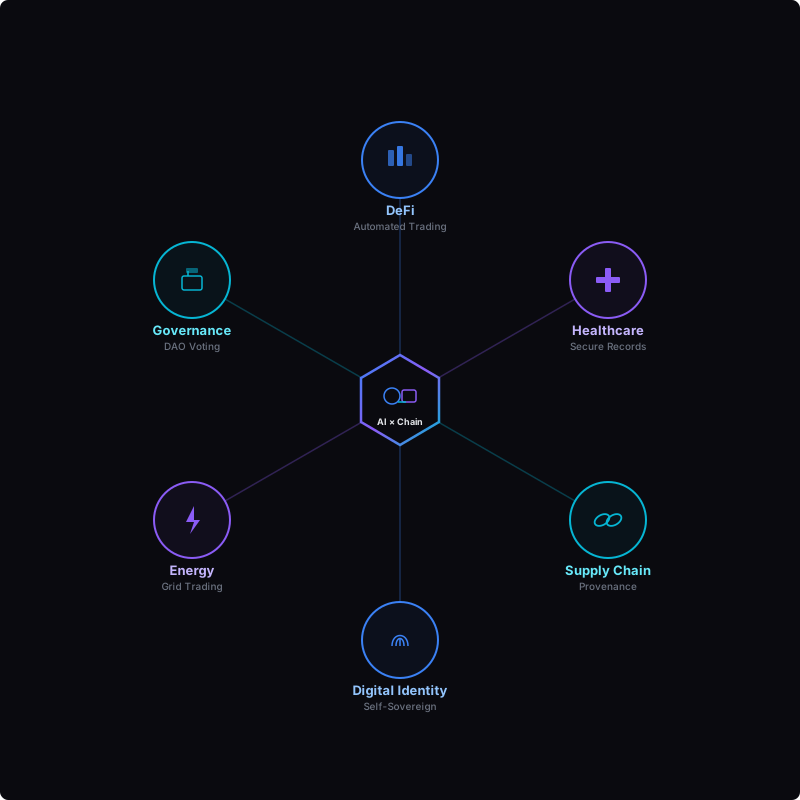
Five Production-Ready Use Cases for Blockchain AI Integration
Let's get specific. These aren't hypotheticals — they're patterns being deployed at scale right now.
1. Decentralized AI Model Marketplaces
One of the most compelling Web3 AI applications is the emergence of decentralized marketplaces where AI models are bought, sold, and used as on-chain assets.
The problem they solve: Today, AI model access is controlled by a handful of large companies. If OpenAI or Google changes their API terms, pricing, or restricts access, downstream businesses are at their mercy. There's also no transparent way to verify that a model performs as advertised, or that your data isn't being used to train future versions.
How it works in 2026:
- AI models are registered on-chain as verifiable assets with cryptographic proofs of their training data, architecture, and performance benchmarks
- Users pay per inference using cryptocurrency, with smart contracts handling payment and access control
- Model performance is validated through decentralized oracle networks that run standardized benchmarks
- Data usage rights are enforced through on-chain licensing agreements
Real-world example: Bittensor has built a decentralized network where AI models compete to provide the best outputs, with validators scoring quality and miners (model operators) earning TAO tokens based on their model's performance. As of early 2026, the network processes over 2 million inference requests daily across 52 specialized subnets covering text generation, image recognition, financial prediction, and more.
Another notable project, Ocean Protocol, focuses specifically on the data layer — enabling data owners to monetize their datasets for AI training while maintaining control and privacy through blockchain-enforced access control.
2. AI-Powered Smart Contracts
Traditional smart contracts are deterministic: they execute the same way given the same inputs. That's a feature — predictability is crucial for financial applications. But it's also a limitation. Many real-world agreements require judgment, interpretation, and adaptation to changing conditions.
Blockchain AI integration enables smart contracts that can:
- Interpret natural language terms and map them to executable logic
- Adjust parameters based on real-world data analysis (not just raw oracle feeds)
- Detect and flag potentially fraudulent transactions before execution
- Optimize DeFi strategies by analyzing market conditions in real time
Practical example: Chainlink's Functions platform now supports AI model calls within smart contracts. A decentralized insurance protocol on Ethereum uses this to process crop insurance claims: satellite imagery is analyzed by an AI model that assesses crop damage, the model's assessment is verified against multiple independent sources, and the smart contract automatically disburses payment when the AI confidence score exceeds 95% and the verification threshold is met.
This eliminates weeks of manual claims processing while maintaining the trustless, transparent execution that blockchain provides.
3. Verifiable AI and Provenance Tracking
As AI-generated content floods the internet — text, images, video, audio — a critical question emerges: how do you know what's real? Blockchain provides a compelling answer.
AI on blockchain for content provenance:
- Creators register original works on-chain with timestamps and ownership metadata
- AI-generated content is tagged with verifiable provenance data: which model, what inputs, when, and by whom
- Consumers and platforms can verify content authenticity by checking the blockchain record
- Deepfake detection AI models publish their assessments on-chain, creating an auditable trail of verification
Real-world deployment: The Coalition for Content Provenance and Authenticity (C2PA) standard, backed by Adobe, Microsoft, and the BBC, has integrated with multiple blockchain networks in 2026. Major news organizations now publish content with on-chain provenance records, and social media platforms use AI models to flag content that lacks verifiable provenance — with the flagging decisions themselves recorded on-chain for transparency.
The scale is growing fast: C2PA-compatible provenance records are being adopted across major news organizations, stock photo platforms, and social networks, with registrations accelerating into the hundreds of millions by early 2026 according to industry tracking by the C2PA consortium.
4. Decentralized AI Training and Federated Learning
Training large AI models traditionally requires massive centralized compute infrastructure — think thousands of GPUs in a single data center. This creates concentration of power and raises privacy concerns when sensitive data must be sent to a central location for training.
Decentralized AI training flips this model:
- Training data stays on the owner's infrastructure (hospitals, banks, individual devices)
- AI models are trained locally, and only model updates (gradients) are shared
- Blockchain coordinates the training process: tracking contributions, distributing rewards, and ensuring no single participant can corrupt the model
- Zero-knowledge proofs verify that participants performed legitimate training computations without revealing their underlying data
Why this matters in practice:
Consider healthcare. Hospitals have valuable patient data that could train life-saving diagnostic AI models. But HIPAA regulations (and basic ethics) prevent them from shipping patient records to Google's data centers. With federated learning coordinated on blockchain:
- Each hospital trains the model on their local data
- Only encrypted model updates are shared
- Blockchain records each hospital's contribution and ensures fair compensation
- The resulting model is better than any single hospital could train alone — without any patient data leaving the hospital
Real-world example: Gensyn has built a decentralized compute network specifically for AI training. Compute providers stake tokens as collateral, perform training work, and are verified through a novel protocol that uses probabilistic proofs to confirm work was done correctly. By early 2026, the network has coordinated training runs equivalent to hundreds of thousands of GPU-hours, with participants spanning 40+ countries.
5. AI-Driven DAO Governance
Decentralized Autonomous Organizations (DAOs) manage billions in assets, but governance participation is notoriously low. Most DAOs see fewer than 5% of token holders voting on proposals. AI agents — autonomous systems that can plan, act, and adapt — are changing this dynamic.
How AI on blockchain enhances DAO governance:
- AI agents analyze proposals, summarize implications, and provide plain-language explanations to token holders
- Delegation agents vote on behalf of token holders according to configurable policy preferences (e.g., "always vote for proposals that increase protocol security," "oppose proposals that dilute tokenomics")
- Risk assessment agents evaluate the financial and technical implications of governance proposals before votes
- Simulation agents model the projected outcomes of proposals under different scenarios
Real-world example: Several major DeFi protocols have integrated AI governance assistants in 2026. Major DeFi governance forums, including Uniswap's, have begun experimenting with AI analysts that break down proposals' expected impact on liquidity providers, traders, and token holders. Early data from DeepDAO suggests that proposals accompanied by AI-generated analysis see significantly higher voter participation — in some cases up to 47% more engagement.
Some DAOs are going further: protocols like MakerDAO are exploring AI risk agents that continuously monitor collateral positions and could autonomously trigger emergency governance votes when systemic risk thresholds are breached — combining AI's analytical power with blockchain's transparent, community-governed execution.
The Technical Architecture: How Blockchain AI Integration Works
Understanding the architecture helps you evaluate which projects are building real technology versus those riding buzzwords.
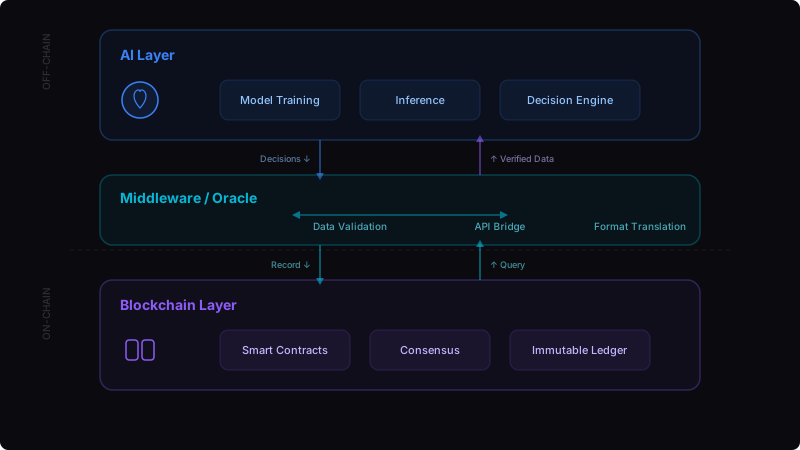
On-Chain vs. Off-Chain AI
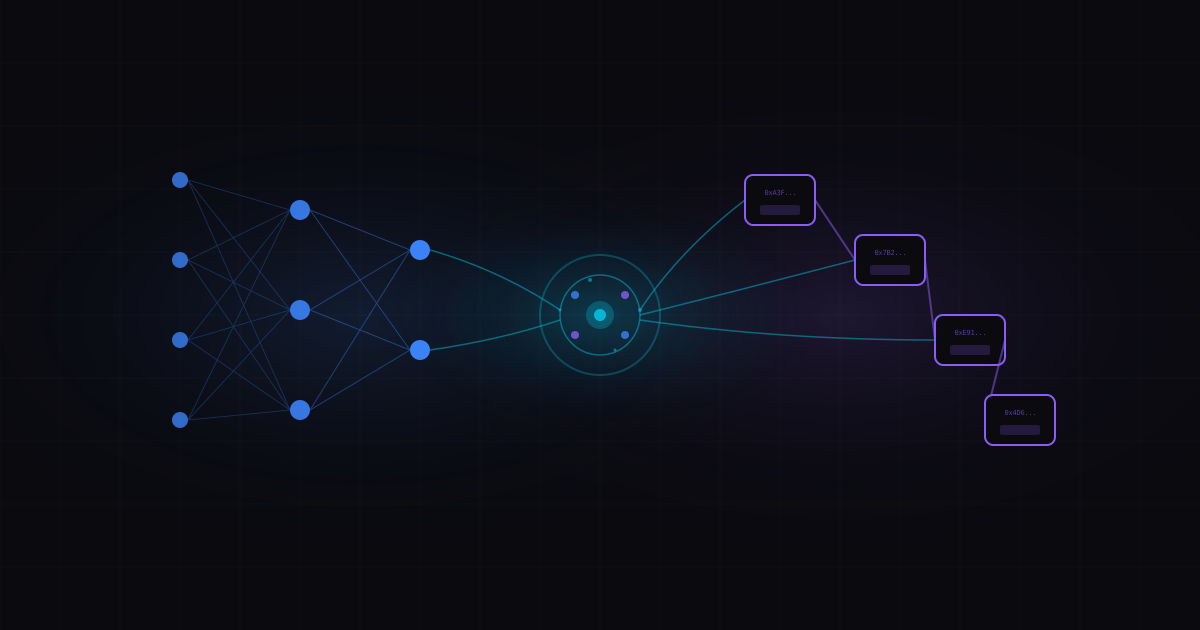
Running AI models directly on-chain is impractical for most use cases. Even the simplest neural network requires more computation than a blockchain transaction can support. The solution is a hybrid architecture:
- AI computation happens off-chain — on dedicated infrastructure (cloud, decentralized compute networks, or edge devices)
- Verification and coordination happen on-chain — the blockchain records what computation was requested, who performed it, what the result was, and whether it was verified
- Bridges connect the two — oracle networks, zero-knowledge proofs, and attestation protocols link off-chain AI work to on-chain records
Zero-Knowledge Machine Learning (zkML)
One of the most exciting technical developments in 2026 is zero-knowledge machine learning — the ability to prove that an AI model produced a specific output from a specific input without revealing the model's parameters or the input data.
Why this matters for blockchain AI integration:
- A DeFi protocol can verify that an AI risk model correctly assessed a loan application without exposing the applicant's financial data
- A decentralized marketplace can prove that an AI model meets claimed accuracy benchmarks without revealing the model's proprietary architecture
- Content verification systems can prove that a deepfake detector ran on a specific piece of content without exposing the detection algorithm
Projects like EZKL and Modulus Labs have made significant progress in making zkML practical, with proof generation times dropping from hours to minutes for medium-sized models.
Token Incentive Design
The economic layer is critical. Decentralized AI systems use tokens to:
- Incentivize compute providers — pay GPU operators for training and inference
- Reward data contributors — compensate data owners for sharing high-quality datasets
- Align validators — stake-based systems where verifiers put up collateral to ensure honest work
- Govern the system — token-weighted voting on protocol upgrades, model selection, and fee structures
Getting the incentive design right is the difference between a functional decentralized AI network and one that collapses under misaligned incentives or gaming.
Challenges and Honest Limitations
No technology convergence comes without friction. Here's what's still hard about blockchain AI integration in 2026.
Scalability
AI workloads are compute-intensive. Blockchains are (by design) slower than centralized systems. Bridging these two realities requires careful architectural choices. Most production deployments use blockchain for coordination and verification — not for running the AI itself. Projects that try to put everything on-chain tend to hit walls quickly.
Complexity
Combining two already-complex technologies creates a steep learning curve. Finding developers who deeply understand both AI/ML and blockchain/cryptography is genuinely difficult. The talent pool is growing but still constrained.
Regulatory Uncertainty
The regulatory landscape for AI is evolving rapidly (the EU AI Act, proposed US federal AI legislation). The regulatory landscape for crypto is also evolving rapidly. The intersection of the two is largely uncharted territory. Projects building in this space need to be prepared for regulatory requirements that don't yet exist.
The "Do You Actually Need Both?" Test
Here's the uncomfortable truth: many projects claiming to use blockchain AI integration don't actually need both technologies. If your AI model works fine on centralized infrastructure and doesn't need verifiable provenance, transparent governance, or decentralized coordination — blockchain adds complexity without proportional value. The strongest use cases are ones where trust, verification, or decentralization are genuine requirements, not marketing buzzwords.
What's Coming Next: Trends to Watch in 2026 and Beyond
The blockchain AI integration space is evolving fast. Here are the trends worth tracking:
- AI agent economies on-chain — autonomous AI agents that hold wallets, transact with other agents, and participate in on-chain markets without human intermediaries. (For a deep dive on how AI agents are transforming automation across industries, see our companion article.) Early implementations are already live on protocols like NEAR and Solana.
- Decentralized model governance — community-governed AI models where training data selection, fine-tuning parameters, and deployment decisions are made through on-chain governance. Think of it as "open source for AI models, but with economic incentives."
- Privacy-preserving AI inference — fully homomorphic encryption and advanced zkML making it possible to run AI inference on encrypted data, with blockchain coordinating the pipeline. Still early, but progressing faster than expected.
- AI-native blockchains — new L1 and L2 chains designed from the ground up to support AI workloads, with built-in support for model verification, compute coordination, and inference markets.
Frequently Asked Questions
Can AI models actually run on a blockchain?
Not in the traditional sense — and that's okay. Running a large language model or neural network directly on-chain would be prohibitively expensive and slow. Instead, blockchain AI integration uses a hybrid approach: AI computation happens off-chain on specialized hardware, while the blockchain handles verification, payment, coordination, and governance. Think of the blockchain as the trust layer and audit trail, not the compute layer. Zero-knowledge proofs and oracle networks bridge the gap between off-chain AI work and on-chain verification.
What are the biggest risks of decentralized AI?
The main risks include data quality and poisoning attacks (malicious participants submitting bad training data to corrupt models), incentive misalignment (tokenomic designs that reward gaming over genuine contribution), regulatory uncertainty (unclear rules for decentralized systems that cross jurisdictions), and the challenge of accountability when no single entity controls the AI. Mitigations include robust validation protocols, stake-based penalty mechanisms, geographic regulatory compliance layers, and transparent governance frameworks. These risks are real but increasingly well-understood.
How is blockchain AI integration different from just using AI APIs with regular databases?
The core difference is trust and control. With a centralized AI API, you're trusting one company with your data, relying on their model quality, and accepting their pricing and terms. With blockchain AI integration, you get verifiable model performance (anyone can audit benchmarks on-chain), data sovereignty (your data stays under your control via federated learning), transparent pricing (smart contracts enforce costs), and censorship resistance (no single entity can cut off access). You pay for this with added complexity. The trade-off makes sense when trust, transparency, or decentralization are critical — not for every use case.
Conclusion: Building at the Intersection
Blockchain AI integration is one of the most consequential technology convergences happening in 2026. Not because either technology is new, but because they've both matured enough to work together on real problems — from decentralized model marketplaces and AI-powered smart contracts to verifiable content provenance and federated learning networks.
The projects that will succeed are the ones solving genuine problems at the intersection: situations where AI's intelligence and blockchain's trust model are both necessary, not just nice-to-have. If you're building in this space, apply the "do you actually need both?" test ruthlessly. If the answer is yes, the opportunity is enormous.
The convergence of Web3 AI applications and autonomous AI systems is creating an entirely new design space for builders. Whether you're developing decentralized AI infrastructure, integrating AI into smart contracts, or building governance tools for DAOs — the foundations are solid and the demand is real.
Want to go deeper on blockchain and AI? Subscribe to the TechLion Blog for weekly analysis of the projects, protocols, and trends shaping the future of decentralized intelligence. No hype — just informed perspective from builders who actually ship.
🧠 Test Your Knowledge
3 questions about this article
Question 1 of 3
How can blockchain enhance AI systems?
Question 2 of 3
What role do smart contracts play in AI-blockchain integration?
Question 3 of 3
What is a challenge of combining AI with blockchain?