AI agents are writing code, managing supply chains, and handling customer support autonomously. Here's how AI agents automation actually works in 2026 — with real use cases and a practical deployment guide.
Contents
How AI Agents Are Changing Automation in 2026
If you've been paying attention to tech over the past year, you've noticed the shift: AI isn't just answering questions anymore — it's doing things. AI agents are booking flights, writing and deploying code, managing supply chains, and negotiating contracts — all without a human hovering over the keyboard. This is AI agents automation at a scale that would have seemed like science fiction just three years ago.
In this article, we'll break down what's actually happening with agentic AI in 2026, separate the hype from reality, and show you concrete examples of how AI workflow automation is reshaping industries right now. Whether you're a founder, developer, or just AI-curious, this is the lay of the land.
What Are AI Agents, and Why 2026 Is Their Breakout Year
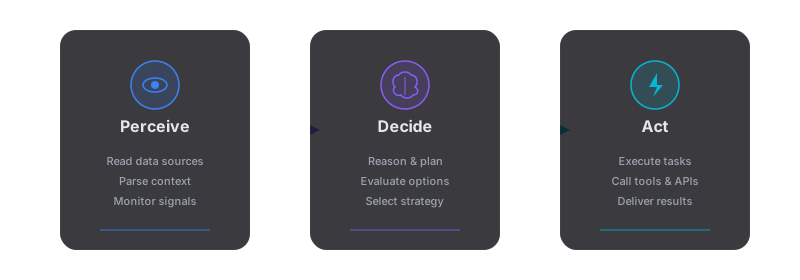
Let's get the basics out of the way. An AI agent is a software system that can perceive its environment, make decisions, and take actions to achieve a goal — with minimal or no human intervention. Unlike a standard chatbot that responds to prompts one at a time, an AI agent can plan multi-step tasks, use tools (APIs, browsers, databases), and adapt when things don't go as expected.
So why is 2026 the inflection point? A few things converged:
- Foundation models got reliable enough. Models like Claude, GPT-5, and Gemini Ultra reached a level of reasoning where they can handle ambiguous, multi-step instructions without derailing. Error rates on complex planning tasks have dropped significantly, with researchers at Stanford's Human-Centered AI Institute reporting single-digit failure rates on multi-step reasoning benchmarks in early 2026.
- Tool-use protocols matured. Standards like Anthropic's Model Context Protocol (MCP) and OpenAI's function-calling spec gave agents a consistent way to interact with external tools — databases, APIs, file systems, browsers — without brittle custom integrations.
- Orchestration frameworks hit prime time. Open-source frameworks like LangGraph, CrewAI, and AutoGen evolved from experimental toys into production-grade platforms. Enterprise adoption of multi-agent orchestration has grown over 3x year-over-year, according to Gartner's latest analysis of AI agent platforms.
- Cost plummeted. Running an agent loop that would have cost $50 in API calls in 2024 now costs under $2, thanks to efficiency gains in inference and caching.
The result? AI agents automation went from "cool demo" to "running in production at Fortune 500 companies" in roughly 18 months.
The Difference Between Copilots and Agents
A quick distinction that matters: copilots assist. Agents act. A copilot suggests code; an agent writes the code, runs the tests, fixes the failures, and opens the pull request. A copilot drafts an email; an agent handles your entire inbox triage, responds to routine messages, and flags only what needs your attention.
This shift from assistance to autonomy is why people call 2026 the year of autonomous AI — and it's not an exaggeration.
Five Real-World Use Cases of AI Agents Automation in 2026
Theory is nice; let's talk about what's actually happening in the wild. Here are five concrete areas where agentic AI deployments are making a measurable impact in 2026.
1. Software Development and DevOps
This is arguably where AI agents have had the most visible impact. Development teams are using agents that can:
- Take a Jira ticket, read the codebase, write the implementation, run tests, and submit a PR
- Monitor production systems, detect anomalies, diagnose root causes, and apply hotfixes
- Refactor legacy codebases by analyzing dependencies and migrating code in safe, incremental steps
Companies like Cognition (with Devin) and smaller startups have shipped agent-powered dev tools that genuinely reduce cycle time. The 2026 Stack Overflow Developer Survey found that 62% of professional developers now use at least one AI agent in their daily workflow — up from 14% in 2024.
Practical example: A mid-size fintech company reported cutting their bug-fix turnaround from 4 days to 6 hours by deploying an AI agent that triages bug reports, reproduces issues in a sandbox, and generates fix PRs overnight.
2. Customer Support and Success
AI agents in customer support have moved well beyond scripted chatbots. Modern support agents can:
- Access CRM data, order history, and internal knowledge bases in real time
- Handle multi-turn, complex conversations (returns, billing disputes, technical troubleshooting)
- Escalate to humans only when confidence drops below a threshold — and hand off with full context
Klarna reported in Q1 2026 that their AI agent handles 78% of customer interactions end-to-end, with customer satisfaction scores higher than their human-only baseline. That's not a typo.
3. Sales and Marketing Automation
AI workflow automation in sales goes far beyond drip campaigns. Agents now:
- Research prospects by crawling LinkedIn, company filings, and news — then craft personalized outreach
- Qualify leads through natural conversation in email or chat
- Update CRM records, schedule follow-ups, and prep meeting briefs automatically
One B2B SaaS company shared that their AI sales agent generates 3x more qualified pipeline than their previous rules-based automation, at 20% of the operational cost.
4. Finance and Accounting
Autonomous AI is finding a natural home in finance operations:
- Invoice processing agents that extract data, match POs, flag discrepancies, and route approvals
- Reconciliation agents that cross-reference bank feeds, ledger entries, and third-party platforms
- Compliance monitoring agents that continuously scan transactions for regulatory red flags
According to McKinsey's analysis of AI in financial operations, firms using AI agents for financial operations report a 40–60% reduction in manual processing time and a 75% decrease in data-entry errors.
5. Healthcare Administration
While clinical AI still moves carefully (and rightly so), administrative AI agents are thriving:
- Prior authorization agents that assemble clinical documentation and submit requests to insurers
- Scheduling agents that coordinate across provider availability, patient preferences, and insurance networks
- Medical coding agents that assign ICD-10 and CPT codes with human-level accuracy
A study published in JAMA Network Open in early 2026 found that AI-assisted prior authorization reduced processing time from 14 days to under 48 hours at participating health systems.
How AI Workflow Automation Actually Works Under the Hood
You don't need to be an ML engineer to understand how AI agents work under the hood — but knowing the basics will help you evaluate tools, spot hype, and make smarter build-or-buy decisions.
The Agent Loop
At its core, every AI agent runs a variation of this loop:
- Perceive — Receive input (user request, system alert, scheduled trigger)
- Plan — Break the goal into sub-tasks, decide what tools to use
- Act — Execute actions (API calls, file writes, browser interactions)
- Observe — Check the results of those actions
- Iterate — Adjust the plan based on what worked and what didn't
This loop repeats until the goal is achieved or the agent determines it needs human input. The key innovation in 2026 isn't any single step — it's that the loop is now reliable enough to run unattended for complex, multi-step tasks.
Multi-Agent Systems
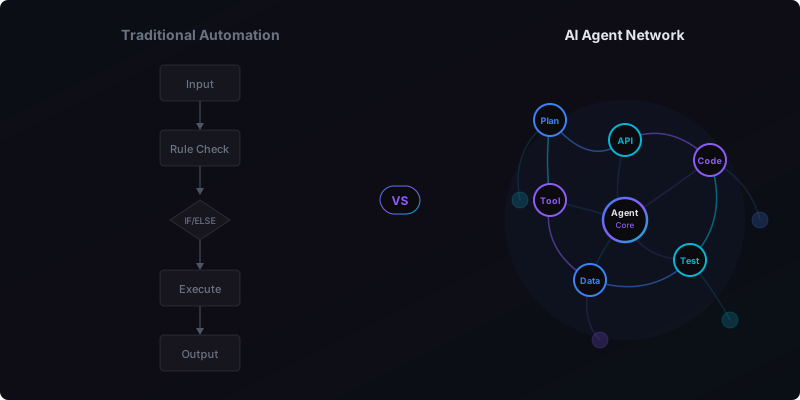
For bigger problems, single agents aren't enough. Multi-agent architectures assign specialized roles:
- A planner agent decomposes the overall goal
- Worker agents handle specific subtasks (research, coding, data analysis)
- A reviewer agent checks quality and consistency
- An orchestrator manages coordination, retries, and resource allocation
This mirrors how human teams work — and it's why frameworks like CrewAI and Microsoft's AutoGen have seen explosive adoption. The 2026 multi-agent paradigm treats AI agents less like tools and more like teams. Interestingly, blockchain technology is enabling entirely new coordination models for AI agent teams, with on-chain governance and token incentives aligning multi-agent systems at scale.
Memory and Context
One of the biggest breakthroughs enabling agentic AI in 2026 is persistent memory. Agents now maintain:
- Short-term memory — the current task context and conversation
- Long-term memory — learned patterns, user preferences, and historical decisions stored in vector databases
- Shared memory — knowledge accessible across multiple agents in a system
This means an agent can remember that you prefer Slack over email for notifications, that your staging environment uses a specific database, or that a particular customer always asks about compliance certifications.
Challenges and Risks: What Could Go Wrong
Let's be honest — AI agents automation isn't all upside. Here are the real challenges the industry is grappling with in 2026.
Reliability and Hallucination
Agents are more reliable than ever, but "more reliable" doesn't mean "perfect." When an agent hallucinates a database query or misinterprets an API response, the consequences can cascade through a multi-step workflow. The industry standard right now is to build agents with guardrails: confirmation steps for high-stakes actions, human-in-the-loop checkpoints, and rollback capabilities.
Security and Access Control
An agent that can access your email, CRM, and codebase is incredibly useful — and incredibly dangerous if compromised. The attack surface for AI agents is fundamentally different from traditional software. Prompt injection attacks, where malicious input tricks an agent into taking unauthorized actions, remain a real concern. Organizations deploying agents need robust sandboxing, permission scoping, and audit logging. Some teams are turning to blockchain-based verification and audit trails to add a tamper-proof layer of accountability to their AI agent deployments.
Job Displacement vs. Job Transformation
The elephant in the room. AI agents are replacing some tasks currently done by humans. But the pattern so far looks more like transformation than elimination — roles shift toward oversight, strategy, and handling the edge cases agents can't. The World Economic Forum's Future of Jobs Report estimates that AI agents will displace 12% of current task hours globally, while creating demand for 8% new task hours in AI oversight, prompt engineering, and agent management roles.
Accountability and Governance
When an autonomous AI agent makes a decision that costs money or affects people, who's responsible? This is an active area of legal and regulatory development. The EU AI Act's 2026 enforcement provisions specifically address autonomous agent systems, requiring clear chains of accountability and mandatory human oversight for high-risk domains.
How to Get Started with AI Agents in Your Organization
Ready to move beyond reading about agentic AI and start deploying it? Here's a practical roadmap.
Start Small: Pick One Workflow
Don't try to automate everything. Identify a single, well-defined workflow that's:
- Repetitive and rule-based (but with enough variation that simple scripts can't handle it)
- Low-risk (mistakes are annoying but not catastrophic)
- Measurable (you can track before/after performance)
Good first candidates: email triage, meeting scheduling, report generation, data entry, or code review.
Choose Your Stack
The AI agents automation ecosystem in 2026 offers several mature options:
| Framework | Best For | Learning Curve |
|---|---|---|
| LangGraph | Complex, stateful workflows | Medium |
| CrewAI | Multi-agent collaboration | Low-Medium |
| AutoGen | Research and enterprise | Medium-High |
| OpenAI Assistants API | Simple tool-using agents | Low |
| Anthropic MCP + Claude | Tool integration, coding agents | Low-Medium |
Build with Guardrails
Every production agent needs:
- Permission scoping — agents should only access what they need
- Human-in-the-loop checkpoints — especially for actions that spend money, send communications, or modify production systems
- Audit logging — every action the agent takes should be logged and reviewable
- Rollback capability — the ability to undo agent actions when things go wrong
- Cost controls — set spending limits to prevent runaway API costs
Measure and Iterate
Track three things:
- Task completion rate — what percentage of tasks does the agent handle end-to-end without human intervention?
- Error rate — how often does the agent make mistakes that require correction?
- Time savings — how much human time is freed up?
Most organizations see meaningful results within 4–6 weeks of deploying their first agent workflow.
Frequently Asked Questions
What's the difference between AI agents and traditional automation (like RPA)?
Traditional automation tools like RPA follow rigid, pre-defined rules — "if field A contains X, copy it to field B." They break when formats change or edge cases appear. AI agents, by contrast, understand context and can adapt to variations. An RPA bot fails when an invoice layout changes; an AI agent reads the invoice, understands the content regardless of format, and processes it correctly. Think of RPA as a macro on steroids and AI agents as a junior employee who actually understands the task.
Are AI agents safe to use with sensitive business data?
They can be — with the right architecture. Best practices in 2026 include running agents in sandboxed environments, using role-based access control to limit what data agents can see and modify, encrypting data in transit and at rest, and maintaining comprehensive audit logs. Many enterprise platforms now offer SOC 2 certified agent hosting. The key is treating agent access with the same rigor you'd apply to a new employee with system access.
How much does it cost to deploy AI agents in 2026?
Costs vary widely depending on complexity. A simple single-agent workflow (email triage, data entry) can run on as little as $50–200 per month in API costs. More complex multi-agent systems for enterprise workflows typically range from $500–5,000 per month. The ROI calculation usually comes down to human hours saved — if an agent eliminates 20 hours of manual work per week at a loaded cost of $50/hour, that's $4,000/month in savings against a few hundred in agent costs.
Conclusion: The Agentic Future Is Already Here
AI agents automation isn't a future prediction — it's the present reality of 2026. From software development to healthcare administration, autonomous AI systems are handling complex, multi-step workflows that were firmly in the "humans only" category just two years ago.
The organizations seeing the biggest gains aren't the ones with the flashiest AI labs. They're the ones that identified specific, measurable workflows, deployed agents with proper guardrails, and iterated based on real results.
If you haven't started experimenting with agentic AI yet, now is the time. Pick one workflow, choose a framework, and build your first agent. The learning curve is shorter than you think, and the productivity gains are real.
Want to stay ahead of the AI agents revolution? Subscribe to the TechLion Blog newsletter for weekly deep dives on AI and blockchain innovation. No fluff, no hype — just the insights that matter.
🧠 Test Your Knowledge
3 questions about this article
Question 1 of 3
What is the primary characteristic that distinguishes AI agents from traditional automation?
Question 2 of 3
Which technology is fundamental to modern AI agent architectures?
Question 3 of 3
What is a key benefit of multi-agent systems in automation?