Learn how AI agents use smart contracts for autonomous blockchain interactions. A developer's guide to architecture, code patterns, and real-world use cases.
Contents
How AI Agents Use Smart Contracts: A Developer's Guide
AI agents are no longer just chatbots answering questions — they're autonomous systems that can hold wallets, execute transactions, and interact with decentralized protocols without human intervention. The bridge between an AI agent's decision-making and the blockchain's execution layer? Smart contracts.
If you've been following the evolution of AI agents in 2026, you've seen them go from experimental curiosities to production-grade systems managing real assets. But building an AI agent that reliably interacts with smart contracts requires understanding a specific set of architecture patterns, security considerations, and design trade-offs that most AI tutorials don't cover.
This guide is for developers who understand the basics of both AI and blockchain and want to build at the intersection. We'll cover the foundational concepts, walk through architecture patterns with code examples, explore real-world use cases, and give you a clear path to getting started with AI blockchain development.
What Are AI Agents?
Before diving into the smart contract integration, let's establish what we mean by "AI agent" — because the term gets thrown around loosely.
An AI agent is a software system that can:
- Perceive its environment — ingesting data from APIs, blockchain events, user inputs, or sensor feeds
- Reason about that data — using machine learning models, rule engines, or large language models to evaluate options and make decisions
- Act on those decisions — executing transactions, calling APIs, sending messages, or triggering workflows
- Learn from outcomes — updating its strategies based on results (in more advanced implementations)
The critical distinction between an AI agent and a regular automation script is autonomy. A cron job that rebalances a portfolio every hour isn't an agent — it's a timer. An AI agent evaluates market conditions, decides whether to rebalance, determines how to rebalance, and executes the trade — adapting its strategy based on what worked and what didn't.
For a deeper dive into agent architectures and how multi-agent systems collaborate, see our dedicated articles on those topics.
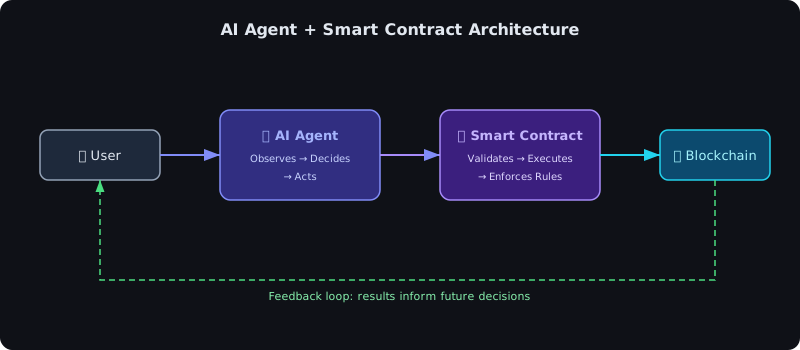
The Agent Loop
At its simplest, every AI agent runs a variation of this loop:
while running:
    observations = perceive(environment)
    plan = reason(observations, goals, memory)
    actions = decide(plan)
    results = execute(actions)
    memory = learn(results, memory)
When smart contracts enter the picture, the execute step becomes significantly more interesting — and more dangerous. Unlike calling a REST API where you can retry on failure, blockchain transactions are irreversible. An agent that sends funds to the wrong address or approves an unlimited token allowance can't undo the mistake.
Why Smart Contracts?
If AI agents can call APIs and interact with databases, why bring smart contracts into the picture at all? Several reasons make blockchain execution uniquely valuable for autonomous agents.
Trustless Execution
When an AI agent operates autonomously — especially when managing money — trust is the central problem. Who verifies the agent did what it was supposed to? Who ensures it didn't get compromised? Smart contracts provide deterministic, auditable execution. The logic is on-chain, visible to anyone, and executes exactly as written. An agent can trigger a smart contract function, and every observer can verify exactly what happened.
Programmable Money
Smart contracts are the only production-grade way to give AI agents direct, programmable access to financial primitives: token transfers, swaps, lending, staking, liquidity provision. DeFi protocols are essentially API endpoints for money, and smart contracts are the interface.
Composability
Smart contracts can call other smart contracts. This means an AI agent can, in a single transaction, swap tokens on a DEX, deposit the result into a lending protocol, and stake the receipt tokens — all atomically. If any step fails, the entire transaction reverts. This composability is impossible with traditional financial infrastructure.
Permissionless Access
No one needs to approve an AI agent's access to a smart contract. If the agent has a wallet with sufficient funds, it can interact with any public smart contract on the network. This is fundamentally different from traditional finance where every new integration requires partnerships, agreements, and approvals.
Verifiable Constraints
Smart contracts can enforce hard limits on what an AI agent can do. A well-designed contract can cap the maximum transaction size, restrict which tokens the agent can interact with, require multi-signature approval above certain thresholds, and enforce time-locks on sensitive operations. This creates a verifiable safety layer that doesn't depend on the agent's own code being correct.
Architecture Patterns for AI Agent + Smart Contract Systems
There are several established patterns for connecting AI decision-making to blockchain execution. The right choice depends on your security requirements, latency tolerance, and the complexity of on-chain interactions.
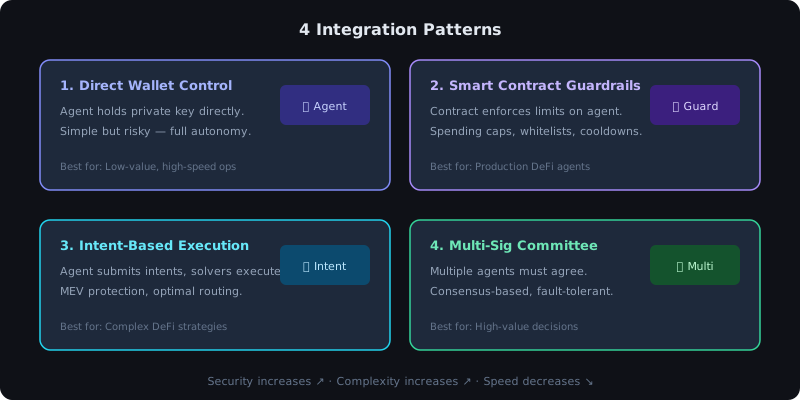
Pattern 1: Direct Wallet Control
The simplest pattern — the AI agent holds a private key and submits transactions directly.
┌─────────────┐     ┌──────────────┐     ┌────────────────┐
│   AI Agent   │────▶│   Web3 SDK   │────▶│ Smart Contract │
│  (Decision)  │     │  (Signing)   │     │  (Execution)   │
└─────────────┘     └──────────────┘     └────────────────┘
Pseudocode:
class DirectWalletAgent:
    def __init__(self, private_key, contract_address, rpc_url):
        self.wallet = Wallet(private_key)
        self.contract = SmartContract(contract_address, abi)
        self.web3 = Web3Provider(rpc_url)

    def execute_swap(self, token_in, token_out, amount):
        # AI decides the trade parameters
        decision = self.model.evaluate_market(token_in, token_out)

        if decision.confidence < 0.85:
            return None  # Not confident enough to trade

        # Build and sign transaction
        tx = self.contract.functions.swap(
            token_in=token_in,
            token_out=token_out,
            amount=amount,
            min_output=decision.min_acceptable_output,
            deadline=current_time() + 300  # 5 minute deadline
        )

        signed_tx = self.wallet.sign(tx)
        tx_hash = self.web3.send_transaction(signed_tx)

        # Wait for confirmation and learn from result
        receipt = self.web3.wait_for_receipt(tx_hash)
        self.model.record_outcome(decision, receipt)

        return receipt
Pros: Low latency, simple architecture, full agent autonomy.
Cons: If the agent is compromised, the attacker gets the private key. No human oversight on individual transactions. Single point of failure.
Best for: Low-value operations, testing, agents operating within heavily constrained smart contracts.
Pattern 2: Smart Contract Guardrails
The agent has wallet access, but the smart contract itself enforces safety constraints. The intelligence is off-chain; the guardrails are on-chain.
# Solidity-style pseudocode for the guardrail contract
contract AgentGuardrail:
    owner: address
    agent: address
    max_transaction_value: uint256
    daily_limit: uint256
    daily_spent: uint256
    allowed_tokens: mapping(address => bool)
    cooldown_period: uint256
    last_action_time: uint256

    function executeAgentAction(target, data, value):
        require(msg.sender == agent, "Only agent can call")
        require(value <= max_transaction_value, "Exceeds per-tx limit")
        require(daily_spent + value <= daily_limit, "Exceeds daily limit")
        require(block.timestamp >= last_action_time + cooldown_period, "Cooldown active")

        daily_spent += value
        last_action_time = block.timestamp

        # Execute the action through the guardrail
        success, result = target.call{value: value}(data)
        require(success, "Action failed")

        emit AgentActionExecuted(target, value, data)
        return result

    function emergencyPause():
        require(msg.sender == owner, "Only owner")
        agent = address(0)  # Disable agent
        emit EmergencyPause()
The AI agent code:
class GuardrailedAgent:
    def __init__(self, wallet, guardrail_contract):
        self.wallet = wallet
        self.guardrail = guardrail_contract

    def execute_action(self, target_contract, action, params):
        # AI makes the decision
        decision = self.model.decide(action, params)

        # Encode the target call
        calldata = target_contract.encode_function(action, params)

        # Execute through guardrail — contract enforces limits
        try:
            tx = self.guardrail.functions.executeAgentAction(
                target=target_contract.address,
                data=calldata,
                value=decision.value
            )
            return self.wallet.sign_and_send(tx)
        except ContractRevert as e:
            # Guardrail blocked the action — learn from it
            self.model.record_blocked_action(decision, str(e))
            return None
Pros: On-chain safety guarantees that don't depend on the agent's code. Owner can pause the agent. Transaction limits are cryptographically enforced.
Cons: Added gas costs for the guardrail layer. Constraints must be defined upfront. More complex deployment.
Best for: Production agents managing significant value. This is the recommended pattern for most real-world deployments.
Pattern 3: Intent-Based Execution
The agent expresses intent (what it wants to achieve), and a separate execution layer figures out the optimal way to fulfill it. This separates decision-making from transaction construction.
┌─────────────┐     ┌──────────────┐     ┌─────────────┐     ┌────────────────┐
│   AI Agent   │────▶│Intent Engine  │────▶│   Solver     │────▶│ Smart Contract │
│  (Intent)    │     │ (Validation)  │     │ (Execution)  │     │  (Settlement)  │
└─────────────┘     └──────────────┘     └─────────────┘     └────────────────┘
class IntentBasedAgent:
    def __init__(self, intent_protocol):
        self.intent_protocol = intent_protocol

    def express_intent(self, goal):
        # AI decides WHAT it wants, not HOW to do it
        intent = self.model.formulate_intent(goal)

        # Example intent:
        # {
        #     "action": "swap",
        #     "input_token": "USDC",
        #     "output_token": "ETH",
        #     "input_amount": 1000,
        #     "min_output": 0.32,    # AI's minimum acceptable output
        #     "deadline": 1711000000,
        #     "max_slippage": 0.005  # 0.5% max slippage
        # }

        # Submit intent — solvers compete to execute it
        intent_id = self.intent_protocol.submit(intent)

        # Monitor execution
        result = self.intent_protocol.await_settlement(intent_id)
        self.model.record_outcome(intent, result)

        return result
Pros: The agent doesn't need to understand DEX routing, gas optimization, or MEV protection. Solvers handle execution complexity. Clean separation of concerns.
Cons: Depends on solver availability and honesty. Added latency. Less control over exact execution path.
Best for: Complex DeFi operations, cross-chain interactions, agents that need MEV protection.
Pattern 4: Multi-Signature Agent Committee
Multiple AI agents must agree before a transaction executes. Inspired by multi-sig wallets but applied to AI decision-making.
class AgentCommittee:
    def __init__(self, agents, multisig_contract, threshold):
        self.agents = agents          # List of independent AI agents
        self.multisig = multisig_contract
        self.threshold = threshold    # e.g., 3 of 5 must agree

    def propose_and_vote(self, action):
        # Each agent independently evaluates the proposed action
        votes = []
        for agent in self.agents:
            assessment = agent.evaluate(action)
            if assessment.approve:
                signature = agent.sign_approval(action)
                votes.append(signature)

        # Check if threshold is met
        if len(votes) >= self.threshold:
            # Submit with collected signatures
            tx = self.multisig.functions.executeWithSignatures(
                action=action.encoded,
                signatures=votes
            )
            return submit_transaction(tx)
        else:
            log(f"Action rejected: {len(votes)}/{self.threshold} approvals")
            return None
Pros: No single agent failure can cause a bad transaction. Different agents can use different models or strategies, providing diversity of analysis. Harder to compromise.
Cons: Higher latency (all agents must evaluate). More infrastructure to manage. Agents could have correlated failures if they share training data.
Best for: High-value treasury management, protocol governance, situations where the cost of a bad decision is extremely high.
Real-World Use Cases
These patterns aren't theoretical. Here's where AI agents and smart contracts are working together in production in 2026.
Autonomous DeFi Portfolio Management
AI agents manage DeFi positions across multiple protocols — rebalancing, harvesting yields, and hedging risk. The agent monitors market conditions, evaluates opportunities across lending protocols (Aave, Compound), DEXs (Uniswap, Curve), and yield aggregators, then executes complex multi-step transactions through guardrailed smart contracts.
A typical flow: the agent detects that USDC lending rates on Aave have dropped below its threshold. It evaluates alternatives, determines that providing USDC-ETH liquidity on Uniswap v4 offers better risk-adjusted returns, withdraws from Aave, swaps a portion to ETH, and deposits into the liquidity pool — all within a single atomic transaction orchestrated through a smart contract.
These agents typically use the guardrail pattern (Pattern 2) with daily limits, allowed-token whitelists, and owner-controlled emergency shutoffs.
AI-Powered Insurance Claims
Parametric insurance protocols use AI agents to evaluate claims and trigger payouts. For crop insurance: satellite imagery is fed to a computer vision model that assesses damage, the model's confidence score is submitted to an oracle contract, and the smart contract automatically processes the claim if the score exceeds the protocol's threshold.
The beauty of this approach is speed and transparency. Traditional crop insurance claims take weeks. An AI agent can evaluate satellite data and trigger a blockchain-verified payout within hours. The smart contract ensures the payout logic is transparent — anyone can audit the conditions under which claims are paid.
Autonomous Trading Agents
AI agents that execute trading strategies across decentralized exchanges. Unlike traditional bots that follow fixed rules, these agents use reinforcement learning models that adapt their strategies based on market conditions, liquidity depth, and historical performance.
The best implementations use the intent-based pattern (Pattern 3), submitting trade intents to solver networks like CoW Protocol that protect against MEV extraction. The agent focuses on strategy; the solvers handle execution quality.
DAO Governance Automation
AI agents that participate in DAO governance on behalf of token holders. The agent analyzes proposals — reading the full text, evaluating financial implications, simulating outcomes — and votes according to configurable policy rules set by the delegating token holder.
These typically use the multi-signature pattern (Pattern 4) for high-stakes votes, requiring multiple independent AI models to agree before casting a vote that could affect millions in protocol funds.
Supply Chain Verification
AI agents that monitor supply chain data and trigger smart contract actions based on verification results. An agent ingests IoT sensor data (temperature, humidity, location) from goods in transit, uses anomaly detection models to flag potential issues, and triggers smart contract events that update shipment status, release escrow payments, or initiate insurance claims.
Security Considerations
Building AI agents that interact with smart contracts is high-stakes development. Here's what you need to get right.
Private Key Management
Never hardcode private keys. Use hardware security modules (HSMs), secure enclaves, or key management services. For production deployments, consider:
# Bad — never do this
agent = Agent(private_key="0xabcdef...")

# Better — environment variable (minimum for dev)
agent = Agent(private_key=os.environ["AGENT_PRIVATE_KEY"])

# Best — HSM or KMS
agent = Agent(key_provider=AWSKMSSigner(key_id="agent-prod-key"))
Transaction Simulation
Always simulate transactions before submitting them. Most EVM-compatible chains support eth_call for dry-run execution:
def safe_execute(self, tx):
    # Simulate first
    try:
        simulation = self.web3.eth.call(tx)
        estimated_gas = self.web3.eth.estimate_gas(tx)
    except ContractRevert as e:
        self.log(f"Simulation failed: {e}")
        return None

    # Check gas cost is reasonable
    if estimated_gas > self.max_gas_limit:
        self.log(f"Gas too high: {estimated_gas}")
        return None

    # Execute for real
    return self.web3.eth.send_transaction(tx)
Allowance Management
Token approvals are one of the most dangerous attack vectors. An agent that sets unlimited approvals on tokens is one exploit away from losing everything.
# Bad — unlimited approval
token.approve(spender=dex_router, amount=MAX_UINT256)

# Good — approve only what's needed for this transaction
token.approve(spender=dex_router, amount=exact_swap_amount)

# Better — reset approval after use
token.approve(spender=dex_router, amount=exact_swap_amount)
execute_swap(...)
token.approve(spender=dex_router, amount=0)  # Reset
Rate Limiting and Circuit Breakers
Implement off-chain rate limiting even if your smart contracts have on-chain guardrails. Defense in depth:
class CircuitBreaker:
    def __init__(self, max_failures=3, cooldown_seconds=3600):
        self.failures = 0
        self.max_failures = max_failures
        self.cooldown = cooldown_seconds
        self.tripped_at = None

    def record_failure(self):
        self.failures += 1
        if self.failures >= self.max_failures:
            self.tripped_at = current_time()
            alert_operator("Circuit breaker tripped!")

    def is_open(self):
        if self.tripped_at is None:
            return False
        if current_time() - self.tripped_at > self.cooldown:
            self.reset()
            return False
        return True  # Circuit is open — block execution
Getting Started: Your First AI Agent + Smart Contract Integration
Ready to build? Here's the practical path from zero to a working AI agent that interacts with smart contracts.
Step 1: Set Up Your Environment
You need a blockchain development environment and an AI framework. For EVM chains:
# Install core dependencies
pip install web3 ethers openai python-dotenv

# For local blockchain testing
npm install -g hardhat

# Initialize a Hardhat project for smart contract development
npx hardhat init
Step 2: Deploy a Guardrail Contract
Start with a simple guardrail contract on a testnet. Use the Pattern 2 design from above — it gives you safety constraints from day one. Deploy to Sepolia or another testnet first. Never develop against mainnet.
Step 3: Build a Minimal Agent
Start with the simplest possible agent loop: observe a single data source (e.g., a token price feed), make a binary decision (buy or don't buy), and execute through your guardrail contract. Don't try to build a complex multi-strategy agent on day one.
Step 4: Add Simulation and Logging
Before your agent sends any real transaction, ensure it simulates every call and logs every decision with full context: what it observed, what it decided, why, and what happened. This is invaluable for debugging and improving your agent's strategy.
Step 5: Graduate to Testnet, Then Mainnet
Run your agent on a testnet for at least two weeks before considering mainnet deployment. Monitor for edge cases: what happens during network congestion? What if the RPC endpoint goes down? What if gas prices spike 10x?
For a complete walkthrough of building your first AI agent, our step-by-step guide covers the full development lifecycle.
Frequently Asked Questions
Can an AI agent hold its own cryptocurrency wallet?
Yes. An AI agent can generate or be assigned a blockchain wallet (a public-private key pair) and use it to sign and submit transactions autonomously. In practice, the agent's code has access to the private key (ideally through a secure key management service, not hardcoded) and uses a Web3 library to construct, sign, and broadcast transactions. The wallet is just an address on the blockchain — it doesn't know or care whether a human or an AI is signing the transactions. The key security question is how you protect the private key and what constraints you put on the agent's spending authority.
How do you prevent an AI agent from making a catastrophic financial mistake?
Defense in depth. First, use smart contract guardrails (Pattern 2) that enforce hard limits on transaction size, daily spending, and allowed tokens — these constraints are cryptographically enforced and can't be bypassed by a buggy or compromised agent. Second, implement off-chain circuit breakers that halt the agent after a configurable number of failures. Third, always simulate transactions before execution. Fourth, start with small amounts and increase limits gradually as the agent proves reliable. Finally, maintain an emergency pause function that lets a human operator disable the agent instantly.
What blockchain is best for AI agent smart contracts?
It depends on your requirements. Ethereum has the most mature ecosystem and tooling, but gas costs can be high for frequent agent transactions. Layer 2s like Arbitrum, Optimism, and Base offer Ethereum-level security with lower costs — they're the sweet spot for most AI agent deployments in 2026. Solana offers high throughput and low latency for agents that need to execute frequently. Cosmos-based chains (like Fetch.ai's network) are purpose-built for agent communication. For most developers starting out, an Ethereum L2 is the pragmatic choice.
Do AI agents need to understand Solidity?
No — the AI agent itself doesn't need to understand or write Solidity. The agent interacts with already-deployed smart contracts through their ABI (Application Binary Interface), which defines the available functions and their parameters. The agent's code uses a Web3 library to encode function calls and submit them as transactions. The agent needs to understand what each contract function does (its business logic), but not how it's implemented in Solidity. That said, the developer building the agent system absolutely needs to understand the smart contracts the agent will interact with — including their edge cases, failure modes, and security properties.
How do AI agents handle blockchain transaction failures?
Robust agents implement retry logic with exponential backoff, transaction replacement (submitting the same transaction with higher gas if the original is stuck), and nonce management to prevent transaction ordering issues. The agent should distinguish between different failure types: a reverted transaction (the contract rejected the action — don't retry the same call), a timeout (the transaction wasn't mined — may need gas increase), and an RPC error (infrastructure issue — retry with a different RPC endpoint). Good agents also learn from failures: if a specific type of transaction keeps reverting, the agent should adjust its strategy rather than blindly retrying.