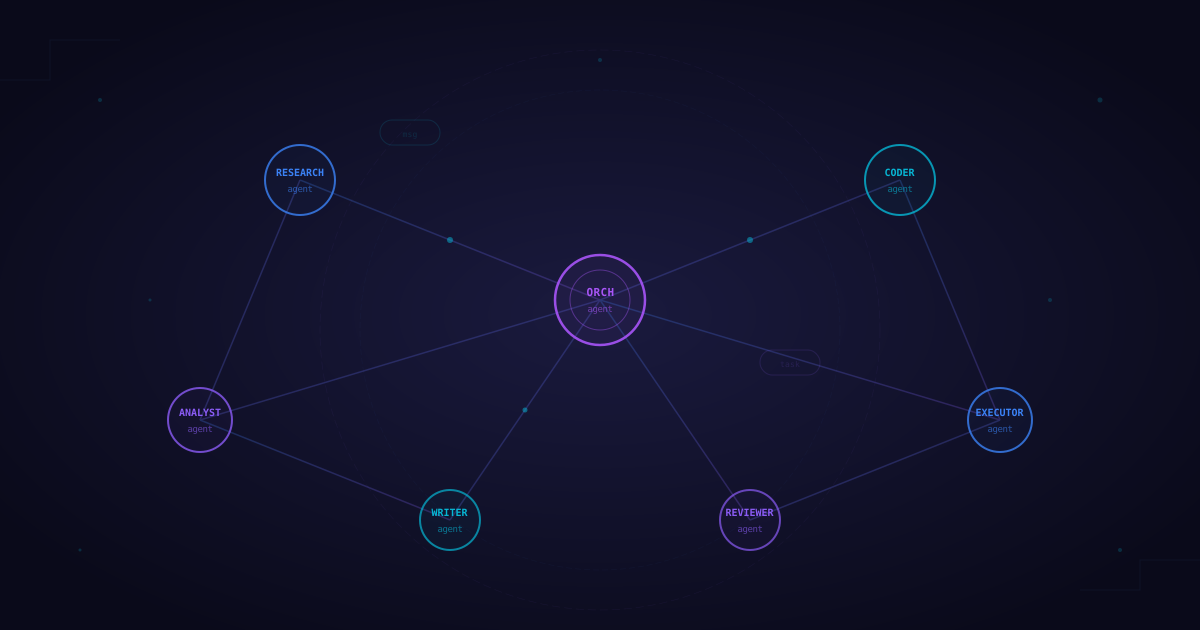
From single agents to collaborative swarms — how multi-agent architectures are reshaping AI development.
Contents
A single AI agent can write code. But can it architect a system, implement the backend, design the frontend, write tests, and review its own work — all while maintaining coherence across those tasks? That's where the limits of single-agent systems become painfully clear, and where multi-agent systems begin to shine.
The shift from monolithic AI agents to collaborative multi-agent architectures represents one of the most significant developments in applied AI. Rather than asking one model to do everything, we're learning to orchestrate teams of specialized agents that communicate, coordinate, and collectively solve problems no single agent could handle alone.
Single-Agent vs. Multi-Agent: Why the Shift?
Single-agent systems have a fundamental scaling problem. As tasks grow in complexity, a single agent must maintain an ever-expanding context window, juggle competing objectives, and switch between radically different skill domains — all within one inference chain.
The problems compound quickly:
- Context window saturation — complex projects require more context than any model can hold effectively.
- Role confusion — an agent asked to both write and review code tends to be overly lenient with its own output.
- Cognitive bottleneck — serial processing of parallel-capable tasks wastes time and introduces unnecessary dependencies.
- Error propagation — a single mistake early in a long reasoning chain corrupts everything downstream.
Multi-agent systems address these limitations by decomposing work across specialized agents, each with a focused role, limited scope, and clear interfaces. The result is closer to how effective human teams operate: not one genius doing everything, but specialists collaborating through well-defined communication protocols.
Communication Protocols
How agents talk to each other is as important as what they do individually. The choice of communication protocol fundamentally shapes a system's capabilities, bottlenecks, and failure modes.
Message Passing
The most common approach. Agents send structured messages to specific recipients or broadcast to a group. Each message typically includes the sender identity, the intended recipient(s), and a payload containing instructions, results, or status updates.
# Simple message-passing protocol
class AgentMessage:
    def __init__(self, sender: str, recipient: str,
                 content: str, msg_type: str = "task"):
        self.sender = sender
        self.recipient = recipient
        self.content = content
        self.msg_type = msg_type  # "task", "result", "feedback", "query"
        self.timestamp = time.time()

class MessageBus:
    def __init__(self):
        self.subscribers: dict[str, list[Agent]] = {}

    def publish(self, message: AgentMessage):
        """Route message to the intended recipient."""
        if message.recipient in self.subscribers:
            for agent in self.subscribers[message.recipient]:
                agent.receive(message)

    def broadcast(self, message: AgentMessage):
        """Send to all registered agents."""
        for agents in self.subscribers.values():
            for agent in agents:
                if agent.name != message.sender:
                    agent.receive(message)
Message passing is explicit and traceable — you can log every interaction and debug communication failures. The downside is overhead: in systems with many agents, message volume can explode quadratically.
Shared Memory (Blackboard Systems)
Instead of direct messages, agents read from and write to a shared workspace — a "blackboard" that serves as the collective knowledge base. Each agent monitors the blackboard for relevant updates, contributes its own findings, and reacts to changes made by others.
class Blackboard:
    def __init__(self):
        self.state: dict[str, any] = {}
        self.watchers: list[callable] = []
        self.history: list[dict] = []

    def write(self, key: str, value: any, author: str):
        """Write a value to the shared blackboard."""
        self.state[key] = value
        entry = {"key": key, "value": value,
                 "author": author, "timestamp": time.time()}
        self.history.append(entry)
        self._notify_watchers(entry)

    def read(self, key: str) -> any:
        return self.state.get(key)

    def _notify_watchers(self, entry: dict):
        for watcher in self.watchers:
            watcher(entry)
The blackboard pattern excels in problems where the solution emerges incrementally — each agent adds a piece, and the complete picture materializes on the board. It's particularly effective for complex analysis tasks where different specialists contribute orthogonal insights.
The trade-off: coordination is implicit. Agents must agree on naming conventions, data formats, and conflict resolution strategies. Two agents writing to the same key simultaneously creates a race condition that requires careful handling.
Structured Protocols
More sophisticated systems define formal interaction protocols — state machines that govern how agents negotiate, delegate, and reach consensus. The Contract Net Protocol, for instance, implements a market-like mechanism where a manager agent broadcasts a task, worker agents submit bids based on their capabilities, and the manager awards the contract to the best bidder.
class ContractNetProtocol:
    """Manager broadcasts tasks, workers bid,
    best bidder gets the contract."""

    def call_for_proposals(self, task: Task, workers: list[Agent]):
        proposals = []
        for worker in workers:
            bid = worker.evaluate_task(task)
            if bid.willing:
                proposals.append(bid)

        if not proposals:
            return None  # No agent can handle this task

        # Select best proposal based on capability + estimated time
        best = min(proposals, key=lambda p: p.estimated_cost)
        best.agent.assign(task)
        return best
This pattern introduces economic reasoning into agent coordination — agents don't just execute, they negotiate. It's particularly powerful in heterogeneous systems where different agents have different capabilities and capacities.
Architectural Patterns
Beyond communication, the organizational structure of a multi-agent system determines how work flows, who makes decisions, and how the system handles failures.
Hierarchical Architecture
A supervisor agent decomposes tasks and delegates to specialized worker agents, which may in turn manage their own sub-agents. This creates a tree-like command structure familiar to anyone who's worked in a large organization.
           ┌─────────────┐
           │  Supervisor  │
           │  (Planner)   │
           └──────┬───────┘
        ┌─────────┼──────────┐
        ▼         ▼          ▼
   ┌─────────┐ ┌────────┐ ┌─────────┐
   │ Backend │ │Frontend│ │   QA    │
   │  Agent  │ │ Agent  │ │  Agent  │
   └─────────┘ └────────┘ └─────────┘
Strengths: Clear authority, predictable execution flow, easy to debug. The supervisor maintains a global view and can reallocate resources as priorities shift.
Weaknesses: Single point of failure at each level. The supervisor's understanding limits the system's capability — if it decomposes a task poorly, all downstream work suffers. Communication must flow up and down the hierarchy, creating latency.
Peer-to-Peer Architecture
No central coordinator. Agents operate as equals, negotiating directly with each other based on their capabilities and current workload. Work distribution emerges from local interactions rather than top-down planning.
Strengths: Resilient to individual failures, naturally scalable, no bottleneck at a central coordinator. New agents can join the system without reconfiguring the hierarchy.
Weaknesses: Harder to guarantee global coherence. Without a supervisor maintaining the big picture, agents may duplicate work, pursue conflicting strategies, or fail to cover important tasks. Consensus mechanisms add overhead.
Pipeline Architecture
Agents are arranged in a sequential chain, each transforming the output of the previous stage. Think of an assembly line: the researcher gathers information, the analyst synthesizes it, the writer produces a draft, the editor refines it.
class Pipeline:
    def __init__(self, stages: list[Agent]):
        self.stages = stages

    async def run(self, initial_input: str) -> str:
        result = initial_input
        for agent in self.stages:
            result = await agent.process(result)
        return result

# Usage
pipeline = Pipeline([
    ResearchAgent(),
    AnalysisAgent(),
    WritingAgent(),
    EditingAgent()
])
final_output = await pipeline.run("Write a market analysis of AI chips")
Strengths: Simple mental model, clear data flow, each agent has a well-defined input/output contract.
Weaknesses: Strictly sequential — the pipeline is as slow as its slowest stage. No feedback loops unless explicitly added. A failure at any stage stalls everything downstream.
Dynamic Orchestration
The most flexible pattern. A router agent examines each incoming task, determines which agents or sub-workflows are needed, and assembles an execution plan on the fly. Different tasks trigger different agent combinations and communication patterns.
This is where the most interesting work is happening today — systems that adapt their own organizational structure based on the problem at hand.
Real Deployments and Frameworks
The multi-agent paradigm has moved well beyond research papers. Several production-grade frameworks are enabling developers to build and deploy collaborative agent systems.
AutoGen (Microsoft)
AutoGen pioneered the conversational multi-agent pattern, where agents interact through structured conversations. Its key insight: you can model complex workflows as conversations between agents with different system prompts and tool access.
A typical AutoGen setup might include a coding agent, an execution agent that runs code in a sandboxed environment, and a critic agent that reviews outputs. The agents converse until they reach a solution, with configurable termination conditions.
AutoGen's strength is its simplicity — if you can describe the collaboration as a conversation, you can implement it. Its limitation is that pure conversation can be inefficient for tasks that would benefit from parallel execution or structured data exchange.
CrewAI
CrewAI takes a more structured approach, organizing agents into "crews" with explicit roles, goals, and backstories. Each agent is assigned specific tools and a clear mandate, and the framework manages task delegation and inter-agent communication.
from crewai import Agent, Task, Crew

researcher = Agent(
    role="Senior Research Analyst",
    goal="Uncover cutting-edge developments in AI",
    backstory="You are a veteran analyst at a leading tech think tank.",
    tools=[search_tool, arxiv_tool],
    verbose=True
)

writer = Agent(
    role="Tech Content Strategist",
    goal="Craft compelling content on tech advancements",
    backstory="You are a renowned content strategist known for "
              "making complex tech accessible.",
    tools=[],
    verbose=True
)

research_task = Task(
    description="Research the latest trends in multi-agent AI systems",
    expected_output="A detailed report with key findings and sources",
    agent=researcher
)

writing_task = Task(
    description="Write a blog post based on the research findings",
    expected_output="A polished 1500-word blog post",
    agent=writer
)

crew = Crew(
    agents=[researcher, writer],
    tasks=[research_task, writing_task],
    verbose=True
)

result = crew.kickoff()
CrewAI's role-based model maps naturally to how teams operate, making it intuitive for developers who think in terms of job functions rather than computational primitives.
MetaGPT
MetaGPT takes the organizational metaphor further, modeling an entire software development company as a multi-agent system. It assigns agents roles like Product Manager, Architect, Engineer, and QA Engineer, each following standard operating procedures (SOPs) that mirror real engineering processes.
What sets MetaGPT apart is its structured output protocol. Rather than free-form conversation, agents produce specific artifacts — PRDs, system design documents, API specifications, code files, test suites — that other agents consume as structured inputs. This reduces ambiguity and makes the system's output more predictable.
The Agency Concept
Beyond specific frameworks, the concept of an "AI Agency" — a persistent organization of agents that operates continuously, accepts work, and delivers results — is gaining traction. Think of it as a virtual company staffed entirely by AI agents, with human oversight at key decision points.
In this model, agents don't just respond to one-off tasks. They maintain ongoing context, develop specialized knowledge over time, and coordinate across long-running projects. The agents have memory, learn from past interactions, and adapt their collaboration patterns based on what works.
This is the direction platforms like OpenClaw are exploring — persistent agent ecosystems where multiple agents coexist, communicate, and evolve their working relationships over time.
Challenges in Multi-Agent Systems
Building multi-agent systems that work reliably in production involves challenges that don't exist in single-agent setups.
Coordination Overhead
More agents means more communication. The coordination cost can easily exceed the computational cost of the actual work, especially if agents are chatty or if the task decomposition is too granular. Finding the right granularity — big enough that each agent does meaningful work, small enough that specialization helps — is more art than science.
Emergent Behavior
When multiple autonomous agents interact, the system can exhibit behaviors that none of the individual agents were designed to produce. Sometimes this is beneficial — creative solutions emerging from agent collaboration. Sometimes it's catastrophic — feedback loops, deadlocks, or cascading failures.
Consistency and Coherence
When multiple agents contribute to a single output (a codebase, a document, a plan), maintaining consistency across their contributions is difficult. Different agents may make conflicting assumptions, use incompatible conventions, or optimize for contradictory objectives.
Observability
Debugging a multi-agent system is fundamentally harder than debugging a single agent. You need to trace interactions across multiple agents, understand the state of shared resources, and identify which agent's decision led to a system-level failure. Logging, tracing, and visualization tools for multi-agent systems are still immature compared to traditional distributed systems tooling.
Cost Management
Each agent invocation costs money (API calls, compute). A poorly designed multi-agent system can burn through budgets quickly if agents engage in excessive back-and-forth, retry loops, or redundant work. Smart systems need circuit breakers, budget limits, and efficiency metrics baked in.
The Future of Agent Swarms
The evolution from single agents to multi-agent systems mirrors a pattern we've seen before in computing: from single-threaded programs to concurrent systems to distributed architectures. Each step introduces new complexity but unlocks capabilities that were impossible at the previous level.
Specialization will deepen. As the ecosystem matures, we'll see agents that are extraordinarily good at narrow tasks — not just "a coding agent" but agents specialized in database migration, API security auditing, or CSS performance optimization. The value will come from orchestrating these specialists effectively.
Self-organizing systems will emerge. Current multi-agent systems require human-designed organizational structures. Future systems will dynamically form teams, elect leaders, and restructure themselves based on task requirements — much like how open-source communities self-organize around projects.
Cross-platform agent interoperability will become essential. Today's frameworks are mostly siloed — AutoGen agents can't easily collaborate with CrewAI agents. Standards for agent communication, capability description, and trust establishment will enable agents from different frameworks (and different organizations) to work together.
Human-agent teams will become the dominant model. Rather than fully autonomous agent swarms, the most effective systems will keep humans in the loop at strategic decision points while delegating execution to agent teams. The human provides judgment, values, and accountability. The agents provide speed, breadth, and tireless execution.
Economic models for agent work will mature. When agents can reliably complete tasks, questions of pricing, quality guarantees, reputation, and accountability become critical. We'll see marketplaces where agent teams compete for work, with track records and performance metrics driving selection.
Conclusion
Multi-agent systems represent a fundamental shift in how we think about AI — from individual intelligence to collective intelligence. The frameworks are maturing, the architectural patterns are being proven in production, and the developer tools are becoming accessible enough for mainstream adoption.
But the real insight isn't technical. It's organizational. The same principles that make human teams effective — clear roles, efficient communication, appropriate authority structures, and shared goals — turn out to apply directly to AI agent teams. The best multi-agent systems aren't just running multiple models in parallel. They're implementing organizational intelligence.
We're at the beginning of this shift. The single-agent paradigm served us well for the first wave of AI applications. The next wave — tackling problems that require diverse expertise, sustained effort, and coordinated execution — belongs to agent teams. The question isn't whether multi-agent systems will become the default architecture for complex AI applications. It's how quickly developers will adopt the patterns and tools to build them effectively.
🧠 Test Your Knowledge
3 questions about this article
Question 1 of 3
What distinguishes multi-agent from single-agent systems?
Question 2 of 3
What is the blackboard communication pattern?
Question 3 of 3
Which framework uses role-based agent collaboration?