Fetch.ai vs SingularityNET vs Ocean Protocol — an in-depth AI blockchain comparison covering technology, tokens, ecosystems, and which project fits your needs.
Contents
Fetch.ai vs SingularityNET vs Ocean Protocol: Compared
If you've spent any time exploring the intersection of artificial intelligence and blockchain, three names keep showing up: Fetch.ai, SingularityNET, and Ocean Protocol. Each claims to be building the decentralized AI future, but they're doing it in fundamentally different ways.
The challenge? Figuring out which one actually matters for your use case — whether you're a developer building AI-powered applications, an investor evaluating the space, or just someone trying to understand where decentralized AI is heading in 2026.
This AI blockchain comparison breaks down the mission, technology, tokenomics, and ecosystem of each project, then puts them head-to-head so you can make an informed decision rather than relying on Twitter hype.
Quick Comparison Table
| Feature | Fetch.ai | SingularityNET | Ocean Protocol |
|---|---|---|---|
| Core Focus | Autonomous AI agents | Decentralized AI marketplace | Data economy & data sharing |
| Native Token | FET | AGIX | OCEAN |
| Blockchain | Cosmos SDK (own L1) | Ethereum + Cardano | Ethereum + multiple chains |
| Primary Users | Developers building autonomous agents | AI researchers & model providers | Data owners & data consumers |
| Key Innovation | Multi-agent economic systems | AI-to-AI service composition | Compute-to-data privacy |
| Governance | Foundation-led with staking | Decentralized (moving toward AGI governance) | Community + token-based |
| Founded | 2017 | 2017 | 2017 |
| Live Mainnet | Yes | Yes | Yes |
Fetch.ai: The Autonomous Agent Network
Mission
Fetch.ai is building an open-access network for autonomous AI agents — software entities that can independently negotiate, transact, and collaborate on behalf of users and organizations. Think of it as an economic internet where AI agents handle complex coordination problems without human micromanagement.
Their thesis is straightforward: the real value of AI isn't in isolated models — it's in networks of agents that can find each other, communicate, and complete multi-step tasks autonomously. Booking travel, optimizing supply chains, managing DeFi positions — all handled by agents that negotiate in real time.
Technology
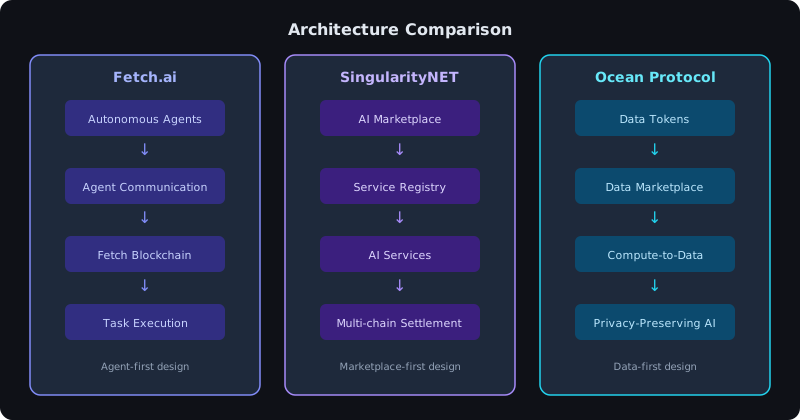
Fetch.ai runs on its own Layer 1 blockchain built with Cosmos SDK, which gives it interoperability with other Cosmos chains and purpose-built infrastructure for agent communication. The tech stack has three core layers:
- Almanac Contract — An on-chain directory where agents register themselves, their capabilities, and their service endpoints. Other agents query this to discover potential collaborators.
- Agent Communication Protocol (ACP) — A standardized messaging protocol that lets agents negotiate, exchange data, and coordinate actions regardless of their underlying implementation.
- DeltaV — A search and discovery layer that acts as an AI-powered interface for finding and invoking agent services. Users describe what they want in natural language, and DeltaV routes the request to the right agents.
The architecture is designed for horizontal scaling — millions of agents operating simultaneously, each one a lightweight process that communicates through the protocol rather than consuming on-chain compute for every interaction.
Token: FET
FET is the utility token powering the Fetch.ai ecosystem. It's used for agent registration, transaction fees, staking for network validation, and as a medium of exchange between agents. The token operates on the native Fetch.ai chain but is also available as an ERC-20 on Ethereum for broader accessibility. Validators stake FET to secure the network and earn rewards, aligning network security with economic participation.
Ecosystem
Fetch.ai's ecosystem is agent-centric. The most active areas include DeFi automation (agents that manage liquidity positions across protocols), mobility and transport optimization, supply chain coordination, and energy grid management. Their partnership with Bosch for industrial IoT automation has been a notable real-world deployment. The developer community has grown significantly, with the uAgents framework making it relatively easy to build, test, and deploy agents.
SingularityNET: The AI Marketplace
Mission
SingularityNET's ambition is the biggest of the three — they're explicitly pursuing Artificial General Intelligence (AGI) through a decentralized, open marketplace of AI services. Founded by Ben Goertzel, one of the most prominent AGI researchers, the project is rooted in the belief that AGI shouldn't be controlled by a single corporation. Democratizing access to AI services is the interim goal; composable AGI is the long-term vision.
Technology
SingularityNET operates as a decentralized marketplace where AI developers publish their models and services, and consumers access them through a standardized API layer. The platform runs on Ethereum and Cardano, giving it access to both ecosystems.
- AI Marketplace — Developers list AI services (image recognition, NLP, predictive analytics, etc.) with standardized interfaces. Users browse, test, and pay for services using AGIX tokens.
- Multi-Party Escrow — Smart contracts handle payment between service consumers and providers, holding funds in escrow and releasing them upon verified service delivery.
- AI-DSL (Domain Specific Language) — A specification language that describes AI service inputs, outputs, and capabilities in a machine-readable format. This is critical for AI-to-AI composition — services can discover and chain together other services automatically.
- OpenCog Hyperon — SingularityNET's next-generation AGI framework, designed to enable different AI paradigms (neural networks, symbolic reasoning, evolutionary algorithms) to interoperate within a unified architecture.
Token: AGIX
AGIX is the marketplace currency. AI service providers earn AGIX for fulfilled requests, and consumers spend AGIX to access services. The token also plays a governance role — AGIX holders can vote on platform development decisions, fee structures, and which AI projects receive ecosystem funding. SingularityNET has also launched the ASI (Artificial Superintelligence Alliance) token through a merger initiative with Fetch.ai and Ocean Protocol, though each project continues to maintain its own ecosystem identity.
Ecosystem
SingularityNET has spawned several significant sub-projects: SingularityDAO (AI-powered DeFi), NuNet (decentralized compute), Rejuve (AI-driven longevity research), and Sophiaverse (social robotics). The ecosystem is research-heavy — many services on the marketplace come from academic AI labs. This gives it depth in cutting-edge AI capabilities but sometimes means services are more experimental than production-ready. The developer community skews toward AI researchers rather than web3 builders.
Ocean Protocol: The Data Economy
Mission
Ocean Protocol takes a fundamentally different angle. While Fetch.ai focuses on agents and SingularityNET on AI models, Ocean Protocol focuses on the fuel that powers both: data. Their mission is to unlock data for AI by creating a decentralized data exchange where data owners can monetize their assets while maintaining privacy and control.
The insight is simple but powerful: AI models are only as good as the data they're trained on. The best data is locked inside organizations that can't or won't share it. Ocean Protocol makes sharing possible by removing the trust problem.
Technology
Ocean Protocol's technology stack is purpose-built for privacy-preserving data exchange:
- Datatokens — Every dataset published on Ocean is represented by an ERC-20 token. Owning a datatoken gives you access rights to the underlying dataset. This turns data access into a tradeable, composable on-chain asset.
- Compute-to-Data (C2D) — The flagship innovation. Instead of sending data to the algorithm, Ocean sends the algorithm to the data. The data never leaves the owner's infrastructure. An AI model runs inside a secure enclave on the data owner's machine, produces results, and only the results are returned to the consumer. The raw data is never exposed.
- Ocean Market — A decentralized marketplace where data providers list datasets and data consumers discover, evaluate, and purchase access. Price discovery happens through automated market makers similar to DeFi liquidity pools.
- Data NFTs — Non-fungible tokens that represent the intellectual property rights to a dataset, separating ownership from access rights and enabling more granular data rights management.
Token: OCEAN
OCEAN is used to buy and sell data access, stake on high-quality datasets (a curation mechanism), and participate in governance. Ocean's Data Farming program incentivizes data providers to publish valuable datasets by distributing OCEAN rewards based on dataset usage and staking activity. The economic model is designed to create a flywheel: more data attracts more AI developers, which generates more demand, which incentivizes more data publishing.
Ecosystem
Ocean Protocol's ecosystem is data-centric. Notable deployments include collaborations with Mercedes-Benz for supply chain data sharing, European Union research projects on privacy-preserving healthcare data exchange, and integration with Gaia-X (the European data infrastructure initiative). The Predictoor product lets users build and monetize prediction feeds using OCEAN staking, adding a DeFi dimension to the data economy.
Head-to-Head Comparison
Problem Focus
This is the most important distinction. These projects aren't really competitors — they're solving different layers of the decentralized AI stack:
- Fetch.ai solves the coordination problem: how do autonomous agents find each other and work together?
- SingularityNET solves the access problem: how do you use AI models without depending on centralized gatekeepers?
- Ocean Protocol solves the data problem: how do you share sensitive data for AI training without losing control?
If you're building a multi-agent system that automates complex workflows, Fetch.ai's infrastructure is purpose-built for you. If you need access to diverse AI capabilities as composable services, SingularityNET is the marketplace. If your bottleneck is data — getting it, sharing it, monetizing it — Ocean Protocol addresses that directly.
Developer Experience
Fetch.ai has the most polished developer experience for agent builders. The uAgents Python framework is well-documented, and you can go from zero to a running agent in under an hour. The learning curve is moderate — you need to understand agent design patterns but don't need deep blockchain expertise.
SingularityNET is more complex. Publishing an AI service requires containerizing your model, defining service metadata in the AI-DSL, and integrating with the platform's SDK. The upside is flexibility — any AI model that can be containerized can become a service.
Ocean Protocol has a clean SDK for data publishers and consumers. The ocean.py library handles datatoken creation, marketplace listing, and compute-to-data orchestration. It's approachable if you're comfortable with Python and basic web3 concepts.
Maturity and Adoption
All three launched in 2017, so they've had time to mature. As of early 2026:
- Fetch.ai has the strongest enterprise traction, with partnerships in automotive, mobility, and industrial IoT.
- SingularityNET has the deepest AI research ecosystem, with hundreds of AI services and active academic partnerships.
- Ocean Protocol has the most regulatory-aligned positioning, with European institutional partnerships and Gaia-X integration.
Token Performance and Utility
All three tokens have utility beyond speculation — they're required to use their respective platforms. The ASI Alliance merger has created interesting dynamics, as the three ecosystems explore token interoperability while maintaining distinct use cases. FET tends to be the most liquid of the three, while OCEAN has the most structured incentive program through Data Farming.
Which Should You Choose?
The right project depends entirely on what you're building:
Choose Fetch.ai if:
- You're building autonomous agents that need to discover and transact with other agents
- Your use case involves complex coordination (supply chains, logistics, DeFi automation)
- You want a dedicated L1 optimized for agent communication
- You're interested in the practical side of AI agent development
Choose SingularityNET if:
- You're an AI researcher wanting to monetize models without going through centralized platforms
- You need to compose multiple AI services into complex pipelines
- You're interested in cutting-edge AI capabilities (NLP, computer vision, reasoning)
- The AGI mission resonates with your long-term vision
Choose Ocean Protocol if:
- Your primary challenge is data access, sharing, or monetization
- Privacy is non-negotiable (healthcare, finance, personal data)
- You want to build AI models on data that can't leave the owner's infrastructure
- You're operating in a regulatory environment that requires data sovereignty
Or use all three. These projects are increasingly interoperable. An autonomous Fetch.ai agent could discover and invoke an AI service on SingularityNET, using training data sourced through Ocean Protocol. That composability is the real promise of the decentralized AI stack.
Conclusion
The Fetch.ai vs SingularityNET vs Ocean Protocol comparison isn't about picking a winner — it's about understanding that decentralized AI needs all three layers: intelligent agents (Fetch.ai), accessible AI services (SingularityNET), and a privacy-preserving data economy (Ocean Protocol).
Each project has real technology, real adoption, and a clearly differentiated position in the market. The hype cycles will come and go, but the underlying problems they solve — agent coordination, AI access democratization, and data sovereignty — aren't going away. If anything, they're becoming more urgent as AI becomes more powerful and more centralized.
The smartest builders in this space aren't picking sides. They're building at the intersections.
Frequently Asked Questions
Are Fetch.ai, SingularityNET, and Ocean Protocol merging?
The three projects formed the Artificial Superintelligence (ASI) Alliance, which includes a token merger initiative. However, each project continues to operate its own network, technology, and ecosystem independently. The alliance is focused on interoperability and a shared vision for decentralized AGI — not a full organizational merger. Think of it as a strategic partnership with token-level coordination.
Which AI blockchain token is the best investment?
This article isn't financial advice, but the investment thesis differs for each. FET benefits from Fetch.ai's enterprise partnerships and agent adoption growth. AGIX tracks with the broader AGI narrative and SingularityNET's research output. OCEAN is tied to the data economy thesis — as AI training data becomes more valuable, the data marketplace model gains traction. Your evaluation should consider which thesis you believe in most, alongside standard crypto investment due diligence.
Can these platforms work together?
Yes, and increasingly they do. A practical example: an autonomous Fetch.ai agent could purchase a privacy-preserving dataset through Ocean Protocol's compute-to-data infrastructure, send that data to an AI model hosted on SingularityNET for analysis, and act on the results — all without a human intermediary. The ASI Alliance is specifically designed to facilitate this kind of cross-platform composability.
How do these compare to centralized AI platforms like OpenAI or Google?
Centralized platforms offer convenience, performance, and polish. Decentralized alternatives offer transparency, censorship resistance, data sovereignty, and community governance. For many use cases, centralized platforms are the pragmatic choice today. The decentralized projects become compelling when you need verifiable AI outputs, can't trust a single provider with your data, or want to participate in AI economies without gatekeepers. It's not either/or — many developers use both.
Do I need blockchain experience to use these platforms?
It helps, but it's not strictly necessary. All three projects have invested heavily in developer experience. Fetch.ai's uAgents framework abstracts most blockchain complexity. SingularityNET's marketplace has a web interface for non-technical users. Ocean Protocol's Python SDK handles wallet management and transaction signing behind clean API calls. If you can write Python and understand API basics, you can start building on any of these platforms.