The definitive guide to the top AI blockchain projects in 2026 — from Bittensor and SingularityNET to Render and Chainlink. What they do, why they matter, and how to evaluate them.
Contents
Top 10 AI + Blockchain Projects to Watch in 2026
The convergence of artificial intelligence and blockchain has produced dozens of projects — but only a handful are building technology that genuinely matters. The AI blockchain projects that survived the hype cycles of 2023-2025 are now shipping production infrastructure, processing millions of requests, and attracting serious developer communities.
This isn't a list of tokens to speculate on. It's an honest assessment of the AI crypto projects in 2026 that have real technology, real usage, and real potential to reshape how AI is built, deployed, and governed. We've evaluated each project on four criteria: technical substance, ecosystem traction, team execution, and long-term vision.
If you're new to the intersection of AI and blockchain, start with our complete guide to decentralized AI for foundational context. If you're already familiar, let's get into it.
1. Fetch.ai (FET)
What it does: Autonomous AI agent infrastructure for blockchain
Why it matters: Fetch.ai has built one of the most mature frameworks for creating AI agents that operate autonomously on blockchain networks. Its agents can discover each other, negotiate terms, and execute transactions without human intervention — enabling everything from automated supply chain optimization to decentralized energy trading.
2026 highlights: The Fetch.ai agent framework now supports multi-chain deployment across Ethereum, Cosmos, and its native Fetch network. The Almanac — a decentralized directory where agents register their services — has grown to over 180,000 registered agents. The merger with SingularityNET and Ocean Protocol under the Artificial Superintelligence Alliance (ASI) has created a unified token and shared infrastructure layer.
What to watch: The ASI Alliance integration timeline and whether the combined ecosystem produces genuinely interoperable tools or remains a collection of loosely connected projects.
2. SingularityNET (AGIX → ASI)
What it does: Decentralized marketplace for AI services
Why it matters: Founded by AI researcher Ben Goertzel — one of the few people in the space with both deep AI expertise and a credible long-term vision for artificial general intelligence — SingularityNET provides a platform where developers publish AI services that anyone can discover, use, and pay for with tokens. Its architecture enables composable AI pipelines where multiple services chain together.
2026 highlights: The marketplace hosts over 120 AI services spanning NLP, computer vision, robotics, and biomedical analysis. The spin-off ecosystem has expanded: SingularityDAO handles AI-driven DeFi portfolio management, NuNet provides decentralized compute, and HyperCycle enables lightweight AI micro-transactions. The AGI research program continues to push toward more general AI capabilities.
What to watch: Whether the marketplace achieves meaningful transaction volume beyond the existing community, and progress on the Opencog Hyperon AGI framework.
3. Ocean Protocol (OCEAN → ASI)
What it does: Decentralized data marketplace and privacy-preserving AI infrastructure
Why it matters: AI is only as good as its training data, and Ocean Protocol solves the fundamental challenge of accessing high-quality data while respecting privacy. Its Compute-to-Data technology allows AI models to train on sensitive datasets — healthcare records, financial data, proprietary research — without the data ever leaving the owner's infrastructure.
2026 highlights: Predictoor, Ocean's decentralized prediction feed system, has processed millions in staked predictions. Data NFTs — representing ownership and access rights to datasets — have been adopted by several research institutions and data cooperatives. The integration with the ASI Alliance is expanding Ocean's reach beyond its core data marketplace into broader decentralized AI pipelines.
What to watch: Adoption of Compute-to-Data by enterprise customers and whether data NFTs gain traction in regulated industries like healthcare and finance. Also, how data sovereignty plays into evolving DeFi and AI integrations.
4. Bittensor (TAO)
What it does: Decentralized intelligence network with competitive AI subnets
Why it matters: Bittensor is arguably the most technically ambitious project on this list. Its network creates a market for machine intelligence: specialized subnets compete to provide the best AI outputs across domains, validators evaluate quality, and miners (model operators) earn TAO tokens proportional to their contribution. It's essentially trying to build a decentralized alternative to OpenAI — not through one giant model, but through a network of competing specialized models.
2026 highlights: The network has grown to over 52 active subnets spanning text generation, image recognition, financial modeling, audio processing, and more. Daily inference volume exceeds 2 million requests. The introduction of dynamic TAO (dTAO) allows market-driven subnet valuation, while the recent Revolution upgrade improved subnet interoperability and cross-subnet task routing.
What to watch: Whether output quality can approach frontier centralized models, subnet economics sustainability (are validators and miners profitable?), and the maturation of cross-subnet communication for complex multi-step AI tasks.
5. Render Network (RENDER)
What it does: Decentralized GPU computing for rendering and AI inference
Why it matters: The AI revolution runs on GPUs, and Render has built one of the largest decentralized GPU networks in the world. Originally focused on 3D rendering for visual effects and motion graphics, Render has expanded into AI inference workloads — offering GPU compute at a fraction of centralized cloud prices. The migration from Ethereum to Solana in 2023 dramatically improved transaction speed and reduced costs.
2026 highlights: The network now supports over 15,000 GPU nodes across 60+ countries. AI inference capabilities have been significantly expanded through partnerships with AI infrastructure providers. The Render Foundation has invested heavily in developer tools, making it easier to deploy AI models on the network. Frame-by-frame rendering jobs and AI inference requests are processed side by side, maximizing GPU utilization across the network.
What to watch: AI workload growth relative to traditional rendering, partnerships with AI model providers, and how Render competes with other decentralized compute providers as the market matures.
6. Akash Network (AKT)
What it does: Decentralized cloud computing marketplace with strong AI/ML focus
Why it matters: Akash is building the decentralized alternative to AWS, Google Cloud, and Azure — with a particular focus on AI and machine learning workloads. Its reverse-auction marketplace lets compute providers bid on jobs, driving prices down to 50-85% below centralized cloud equivalents. For independent AI researchers and smaller companies priced out of centralized cloud GPU instances, Akash is a lifeline.
2026 highlights: GPU compute availability on Akash has expanded significantly, with providers offering NVIDIA A100s, H100s, and consumer-grade GPUs. The launch of persistent deployments — workloads that run continuously rather than as one-off jobs — has made Akash viable for production AI inference serving, not just training runs. Developer tooling has improved with Terraform-compatible deployment specs and a streamlined CLI.
What to watch: Enterprise adoption, uptime and reliability metrics compared to centralized cloud, and whether the marketplace achieves enough liquidity on both supply and demand sides to sustain competitive pricing.
7. Numerai (NMR)
What it does: AI-powered decentralized hedge fund
Why it matters: Numerai is a unique proposition: a hedge fund built on crowdsourced AI. Thousands of data scientists build machine learning models that predict financial markets, stake NMR tokens on their predictions, and earn rewards when their models perform well. The fund aggregates the best predictions into its meta-model for actual trading. It's a live, production demonstration of decentralized AI applied to one of the most demanding domains — financial markets.
2026 highlights: The tournament has attracted over 15,000 data scientists globally. The staking mechanism has been refined to better align incentives, with the introduction of reputation scoring that weights historical model performance. Numerai Signals — which accepts predictions from external data sources — has expanded the range of strategies the fund can incorporate. Total assets under management have grown substantially as the meta-model's risk-adjusted returns continue to outperform many traditional quant strategies.
What to watch: Long-term fund performance, expansion into new asset classes, and whether the decentralized prediction model can consistently outperform centralized quant funds with bigger data budgets.
8. Alethea AI (ALI)
What it does: Decentralized protocol for AI-generated characters and interactive content
Why it matters: While most AI blockchain projects focus on infrastructure, Alethea AI tackles the application layer — specifically, AI-generated characters that can think, speak, and interact autonomously. Its CharacterGPT technology generates interactive AI characters from text descriptions, and the protocol enables these characters to be owned, traded, and governed as on-chain assets.
2026 highlights: CharacterGPT v3 introduced multi-modal characters with voice, visual, and personality capabilities. The AI Protocol has established a decentralized framework where character creators, AI model providers, and infrastructure operators collaborate. Partnerships with gaming studios and metaverse platforms have created distribution channels beyond the crypto-native audience. The ALI token governs the protocol and serves as the payment mechanism for character generation and interaction.
What to watch: Consumer adoption beyond Web3 early adopters, integration with mainstream entertainment and gaming platforms, and competition from centralized AI character platforms (Character.ai, etc.).
9. Worldcoin (WLD)
What it does: Global identity and financial network using AI-powered biometric verification
Why it matters: In a world increasingly flooded with AI-generated content and AI agents operating autonomously, proving you're human becomes critical infrastructure. Worldcoin's approach — using a biometric device (the Orb) to create privacy-preserving proof of personhood — is controversial but addresses a genuine problem. World ID enables "proof of humanness" without revealing personal identity, potentially serving as the trust layer for decentralized AI systems.
2026 highlights: World ID verification has scaled to millions of users across numerous countries. The World App has become a functional financial platform with payments, swaps, and DeFi integrations. The open-sourcing of the biometric verification protocol has allowed third-party developers to build applications that leverage proof of humanness. The World Chain L2 launched to handle the growing transaction volume.
What to watch: Regulatory reception globally (especially around biometric data), adoption of World ID as a standard for bot detection and sybil resistance in decentralized AI networks, and privacy guarantees as the network scales.
10. Chainlink (LINK)
What it does: Decentralized oracle network connecting AI and blockchain
Why it matters: Every AI blockchain project on this list needs a way to connect on-chain smart contracts with off-chain data and computation — and Chainlink is the dominant infrastructure for exactly that. Its oracle network provides verified, tamper-proof data feeds that smart contracts use for everything from DeFi pricing to AI model outputs. Chainlink Functions enables smart contracts to call external APIs, including AI models, directly.
2026 highlights: Chainlink Functions has become the primary way AI capabilities are integrated into smart contracts. Cross-Chain Interoperability Protocol (CCIP) enables AI-powered applications to operate across multiple blockchains. The DECO protocol brings zero-knowledge proof-based data verification to oracle feeds. Data Streams provides low-latency data for time-sensitive AI applications. Chainlink secures hundreds of billions in DeFi value, making it critical infrastructure for the entire space.
What to watch: Competition from newer oracle protocols, expansion of Chainlink Functions into more complex AI workloads, and the development of CCIP as a standard for cross-chain AI applications.
How to Evaluate AI Blockchain Projects
Not all AI crypto projects are created equal. Here's a framework for separating signal from noise:
Technical Substance
- Does the project need both AI and blockchain? Apply the "remove one technology" test. If the product works just as well without blockchain, it's crypto-washing. If it works without AI, it's AI-washing. The strongest projects need both.
- Is there working technology? Check GitHub repositories, testnet deployments, and mainnet usage data. Whitepapers are promises; code is evidence.
- How sophisticated is the AI component? Some projects claim "AI" but use basic automation or simple heuristics. Look for genuine machine learning — model training, inference serving, or novel AI research.
Ecosystem Traction
- Developer activity — GitHub commits, contributors, developer documentation quality, and hackathon participation
- Usage metrics — Inference requests, data transactions, compute hours, and active participants (not just token holders)
- Partnership quality — Partnerships with established AI research institutions, enterprise customers, or complementary blockchain projects carry more weight than marketing partnerships
Token Economics
- Utility — Does the token serve a necessary function in the protocol, or could the system work with a stablecoin?
- Sustainability — Are token emissions funding real development and ecosystem growth, or just attracting mercenary capital?
- Distribution — Is token ownership concentrated among insiders, or broadly distributed across participants?
Team and Governance
- Technical credentials — Does the team include people with genuine AI research backgrounds, not just crypto marketing experience?
- Execution history — Have they shipped what they promised? Check roadmap commitments against actual deliveries.
- Governance maturity — Is governance real (meaningful on-chain votes with diverse participation) or performative?
The Bigger Picture
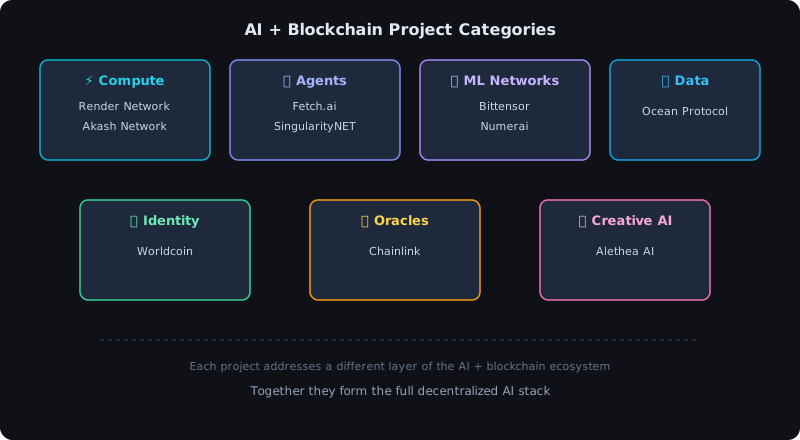
These ten AI blockchain projects represent different layers of a new technology stack for decentralized intelligence. Compute providers (Akash, Render) form the base layer. Data infrastructure (Ocean Protocol) feeds the models. Model networks (Bittensor, SingularityNET) deliver intelligence. Agent frameworks (Fetch.ai) enable autonomous action. Oracles (Chainlink) connect everything to existing smart contract ecosystems. And identity infrastructure (Worldcoin) provides the trust foundation.
The most interesting developments will happen at the intersections — when agents built on Fetch.ai access models running on Bittensor, trained on data from Ocean Protocol, served on Akash compute, with identity verified by Worldcoin and contract execution secured by Chainlink. That full-stack decentralized AI vision is still being assembled, but the pieces are falling into place faster than most people realize.
For builders, the opportunity is in these intersection points. For investors, the bet is on which projects become essential infrastructure versus which get commoditized. And for everyone else, the promise is an AI future that's more open, more transparent, and more accountable than the centralized alternative.
Frequently Asked Questions
Which AI blockchain project is the best investment?
There's no single answer — it depends on your risk tolerance, investment horizon, and thesis. Infrastructure plays (Chainlink, Render, Akash) tend to be lower risk because they serve multiple use cases regardless of which specific AI applications win. Protocol plays (Bittensor, SingularityNET) have higher upside but depend on their specific approach succeeding. Rather than picking one winner, consider diversifying across the stack — compute, data, models, and infrastructure. And always evaluate based on technology and usage metrics, not just token price momentum.
Are AI crypto projects just hype?
Some are. The 2023-2024 AI narrative attracted a wave of projects that added "AI" to their marketing without meaningful technology. But the projects in this article have shipped working products, attracted real users, and survived multiple market cycles. The test is straightforward: check for production deployments, active developer communities, and genuine usage metrics. If a project has all three, it's not just hype.
How do AI blockchain projects make money?
Revenue models vary by layer. Compute networks (Akash, Render) take fees from matching compute providers with customers. Model networks (Bittensor) earn through inference fees. Data marketplaces (Ocean) take transaction fees on data purchases. Agent platforms (Fetch.ai) monetize through agent registration and transaction fees. Oracle networks (Chainlink) charge for data feed access and Functions calls. Most also have treasury funds from token emissions that fund development. The sustainability question is whether fee revenue can eventually replace token emission subsidies.
Can these projects survive a crypto bear market?
The projects most likely to survive are those with genuine usage that persists regardless of token prices. Compute networks where customers save money versus AWS, data marketplaces serving enterprise needs, and oracle networks securing DeFi infrastructure all have demand drivers independent of speculation. Projects that depend primarily on token speculation for user interest are more vulnerable. Look at usage metrics during the 2022-2023 bear market — projects that maintained or grew activity during that period have demonstrated resilience.
How do I start building on decentralized AI platforms?
Most projects have developer documentation and grant programs. Start by picking the layer that matches your skills: if you're an ML engineer, try deploying a model on Bittensor or running inference on Akash. If you're a data scientist, explore Ocean Protocol's data marketplace or Numerai's tournament. If you're a smart contract developer, experiment with Chainlink Functions to call AI models from your contracts. Many projects also run hackathons with mentorship and prizes. Check out our guide to building your first AI agent for a practical starting point.
Conclusion
The AI blockchain projects worth watching in 2026 aren't the ones with the flashiest marketing — they're the ones quietly building infrastructure that developers actually use. The ten projects in this guide represent the most technically substantial, well-executed efforts at the intersection of AI and blockchain.
The space will consolidate. Not all of these projects will be independent entities in five years — mergers like the ASI Alliance (Fetch.ai + SingularityNET + Ocean Protocol) signal that consolidation is already underway. What matters is whether the underlying technology and token ecosystems continue serving real users with real needs.
Keep building. Keep evaluating. And apply the simple test: does this project need both AI and blockchain to work? If yes, you're looking at the future. If not, you're looking at marketing.