Explore how tokenized AI models use blockchain and crypto to democratize machine learning, breaking Big Tech's monopoly on artificial intelligence.
Contents
What Are Tokenized AI Models?
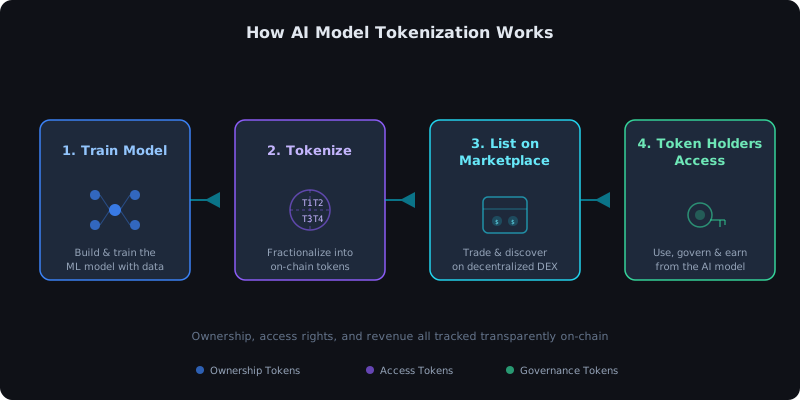
A tokenized AI model is a machine learning model whose ownership, access rights, or computational output is represented as tokens on a blockchain. Instead of a single corporation owning and controlling a model end-to-end, tokenization splits that control into programmable, tradeable units.
Think of it like this: OpenAI builds GPT and charges you per API call. They own the model, the weights, the infrastructure, the revenue stream. Tokenized AI flips that. The model lives on a decentralized network. Contributors who train it, host it, or improve it earn tokens. Users pay in tokens. Governance happens through token voting.
It's not just a financing mechanism — it's a fundamentally different architecture for how AI gets built, distributed, and monetized.
Three core components make this work:
- Ownership tokens — represent a stake in the model itself (training data contributions, compute provided, intellectual property)
- Access tokens — grant the right to query or use the model, replacing traditional API keys with on-chain credentials
- Governance tokens — give holders voting power over model updates, training data policies, and revenue distribution
This isn't theoretical. Projects like Bittensor, Ocean Protocol, and SingularityNET have been building this infrastructure for years. In 2026, the ecosystem is mature enough that tokenized AI models are processing millions of inference requests daily.
The Problem: Big Tech's AI Monopoly
The concentration of AI capabilities in a handful of corporations is one of the defining challenges of this decade. Consider the numbers:
- Training a frontier model costs $100M–$1B+ in compute alone
- The top 5 AI labs control an estimated 90%+ of frontier model capabilities
- GPU clusters required for competitive training are owned by fewer than 20 organizations globally
- Training data pipelines require legal teams, licensing deals, and infrastructure that startups can't replicate
This creates a vicious cycle. Big Tech has the compute, data, and talent to build the best models. The best models attract the most users. The most users generate the most revenue and data. That revenue funds more compute. Rinse, repeat.
For developers, researchers, and businesses outside this circle, the options are limited: pay per API call, fine-tune open-source models with limited resources, or accept inferior capabilities.
The implications go beyond business. When a handful of companies control the most powerful AI systems, they also control:
- What gets built — models optimized for ad revenue, not public good
- Who gets access — pricing that excludes developing nations and small businesses
- Safety decisions — alignment choices made behind closed doors
- Data governance — your data trains their models, and you get nothing back
Tokenization doesn't magically solve all of these problems. But it introduces market mechanisms and ownership structures that create genuine alternatives. For a deeper look at how decentralized approaches tackle these challenges, see our complete guide to decentralized AI.
How AI Model Tokenization Works
The technical architecture of tokenized AI varies by project, but the general pattern follows a consistent structure.
1. Model Registration and Fractionalization
A trained model — or the right to train one — is registered on-chain. Smart contracts define the tokenomics: how many tokens represent full ownership, how revenue splits work, and what governance rights token holders have.
This isn't uploading model weights to a blockchain (that would be absurdly expensive and slow). Instead, the blockchain serves as a coordination and settlement layer. Model weights live on decentralized storage (IPFS, Arweave, Filecoin) or on validator nodes. The blockchain tracks ownership, access rights, and payments.
2. Compute Contribution and Staking
Network participants stake tokens to provide compute resources — GPUs for training and inference. In return, they earn rewards proportional to their contribution. This is similar to proof-of-stake consensus, but instead of validating transactions, nodes are validating AI outputs.
The key innovation is proof of inference or proof of learning — mechanisms that verify a node actually performed the computation it claims. Without this, participants could stake tokens, claim they ran inference, and pocket rewards without doing the work.
3. Inference Markets
When a user queries a tokenized model, the request routes to available compute nodes through an on-chain marketplace. The user pays in the network's native token. The payment flows to:
- Compute providers (for running the inference)
- Model creators (royalties for the intellectual property)
- Data providers (if training data contributors are tracked)
- The protocol treasury (for ongoing development)
This creates a transparent, programmable value chain where every participant gets compensated based on their contribution.
4. Governance and Model Updates
Token holders vote on critical decisions: Should the model be retrained? What data should be included or excluded? How should safety filters work? What's the pricing structure?
This is where tokenized AI gets genuinely interesting from a societal perspective. Instead of a single corporation making alignment decisions, a distributed community of stakeholders debates and votes. It's messier, slower, and sometimes chaotic — but it's also more representative and transparent.
Key Projects Building Tokenized AI
The landscape of top AI blockchain projects in 2026 is broad, but three stand out for their approach to model tokenization.
Bittensor (TAO)
Bittensor operates the most ambitious tokenized AI network. Its architecture consists of subnets — specialized networks where miners compete to produce the best AI outputs for specific tasks (text generation, image recognition, data scraping, financial prediction, etc.).
How it works: Validators evaluate miner outputs and distribute TAO rewards based on quality. This creates a Darwinian marketplace where the best models and compute providers earn the most. Subnet owners design incentive mechanisms specific to their domain.
Current scale: 50+ active subnets processing diverse AI workloads. TAO has become the de facto token for decentralized AI compute.
The bull case: Bittensor doesn't need to beat OpenAI at every task. It needs to create enough specialized subnets where decentralized competition produces better results than centralized alternatives. For niche tasks — domain-specific models, censorship-resistant inference, privacy-preserving computation — it's already winning.
Ocean Protocol (OCEAN)
Ocean focuses on the data layer. Its thesis: AI models are only as good as their training data, and the current data economy is broken. Individuals and organizations produce valuable data but capture almost none of its value.
How it works: Data providers tokenize their datasets as "datatokens." Buyers purchase these tokens to access training data. Compute-to-data functionality lets buyers train models on sensitive data without the data ever leaving the provider's infrastructure.
Key innovation: Predictoor — a prediction market framework where participants stake OCEAN on data-driven forecasts. This creates a financial incentive to provide high-quality, actionable data.
The bull case: If AI is the new oil, data is the crude. Ocean is building the commodity exchange. As regulatory pressure increases around data rights (GDPR, AI Act, emerging US legislation), Ocean's privacy-preserving data marketplace becomes increasingly relevant.
SingularityNET (AGIX)
SingularityNET takes a platform approach — it's a marketplace where anyone can publish, discover, and monetize AI services. Think of it as a decentralized API marketplace for AI.
How it works: Developers deploy AI services to the network and set pricing in AGIX tokens. Users browse the marketplace, find services that match their needs, and pay per call. The platform handles discovery, reputation, and payment settlement.
Key differentiator: SingularityNET emphasizes composability. Complex AI pipelines can chain multiple services together — a translation model feeding into a sentiment analysis model feeding into a report generator — with payments flowing automatically to each service provider.
For a detailed comparison of how these three projects compete and complement each other, check out our Fetch.ai vs SingularityNET vs Ocean Protocol analysis.
The Investment Landscape
Tokenized AI sits at the intersection of two massive narratives: AI and crypto. That makes it one of the most actively traded sectors in digital assets — and one of the most volatile.
Market Structure
The tokenized AI sector has evolved from pure speculation into something with measurable fundamentals:
- Revenue metrics — protocols like Bittensor generate real compute fees; Ocean processes real data transactions
- Usage metrics — inference requests, active subnets, unique users, and data assets listed
- Staking yields — participants earn returns by providing compute or data, creating yield-bearing positions
Investment Approaches
Direct token exposure: Buying TAO, OCEAN, AGIX, or other AI tokens. High volatility, high potential upside, requires conviction in specific projects.
Compute provision: Running validator or miner nodes on networks like Bittensor. Requires hardware investment but generates token-denominated yield. The economics resemble GPU mining but with AI workloads instead of hash functions.
Data provision: Tokenizing and selling datasets through Ocean Protocol. Lower hardware requirements, but demands access to valuable, unique data.
DeFi integration: AI tokens are increasingly integrated into DeFi protocols — lending, liquidity provision, and structured products. The convergence of DeFi and AI-driven machine learning is creating new financial primitives that didn't exist a year ago.
Valuation Frameworks
Traditional crypto valuation metrics (fully diluted value, circulating supply, etc.) apply, but tokenized AI adds domain-specific metrics:
- Cost per inference vs. centralized alternatives (OpenAI, Anthropic, Google)
- Model quality benchmarks — do decentralized models actually compete on output quality?
- Network utilization — what percentage of staked compute is actively processing requests?
- Data marketplace volume — are real buyers paying for real data?
Risks and Challenges
Tokenized AI is not a guaranteed revolution. Several serious risks deserve attention.
Quality Gap
Decentralized models still lag behind frontier centralized models on many benchmarks. GPT-5 and Claude 4 didn't become world-class by committee — they required massive coordinated investment in training runs, RLHF, and safety testing. Tokenized networks struggle to coordinate this level of focused effort.
Regulatory Uncertainty
AI regulation is evolving rapidly. The EU AI Act, proposed US legislation, and emerging global frameworks could impose compliance requirements that decentralized networks struggle to meet. Who's responsible when a tokenized model produces harmful outputs? The token holders? The compute providers? The protocol developers?
Token Volatility
When your AI infrastructure costs are denominated in a volatile token, business planning becomes difficult. A 40% token price drop means your compute costs effectively doubled (or your revenue halved, depending on which side you're on).
Sybil Attacks and Gaming
Incentive mechanisms are hard to get right. If validators can be gamed — submitting low-quality outputs that pass verification, colluding to split rewards, or manipulating governance votes — the entire value proposition collapses.
Scalability
On-chain coordination adds latency and cost. For real-time AI applications (autonomous vehicles, high-frequency trading, interactive assistants), the overhead of blockchain settlement may be unacceptable.
The Bull Case for Tokenized AI
Despite the risks, the structural advantages are compelling:
Censorship resistance. No single entity can shut down a tokenized model or restrict access based on geography, politics, or business competition. For researchers in authoritarian regimes, journalists, and activists, this matters.
Cost efficiency. Decentralized compute markets create price competition. When thousands of GPU providers compete for inference requests, prices trend toward marginal cost. Early data suggests 30–60% cost savings vs. centralized API providers for equivalent-quality models.
Innovation velocity. Open incentive mechanisms attract global talent. A researcher in Lagos can contribute a novel training technique and earn tokens — no visa, no relocation, no corporate hiring process required.
Aligned incentives. When users, developers, and compute providers all hold the same token, their interests align. Everyone benefits from the network being more useful, more efficient, and more widely adopted.
Composability. Tokenized AI services can be combined like DeFi money legos. A single transaction can route through multiple models, data sources, and compute providers — creating AI pipelines that no single company could build alone.
The most likely outcome isn't that tokenized AI replaces Big Tech entirely. It's that it creates a complementary ecosystem — one that serves use cases where decentralization, transparency, and open access matter more than raw performance on frontier benchmarks.
FAQ
How do tokenized AI models differ from open-source AI?
Open-source AI shares code and weights freely but doesn't solve the economic problem. Someone still needs to pay for compute, training, and ongoing development. Tokenization adds an economic layer: contributors earn tokens, users pay tokens, and the network sustains itself through market mechanisms rather than corporate sponsorship or donations. Open-source gives you the model; tokenization gives you the model plus a sustainable business model for everyone involved.
Can I invest in tokenized AI models without technical knowledge?
Yes. The simplest approach is buying tokens like TAO, OCEAN, or AGIX through major exchanges. This gives you exposure to the sector without running nodes or providing compute. However, like any crypto investment, you should understand the fundamentals — what the protocol does, how it generates value, and what risks it faces. Start with the project documentation and community resources before committing capital.
What hardware do I need to participate as a compute provider?
Requirements vary by network and role. Bittensor miners typically need high-end GPUs (NVIDIA A100, H100, or equivalent) for competitive performance. Validators have lower requirements. Ocean Protocol data providers need minimal hardware — just a server to host datasets. Entry costs range from a few hundred dollars (basic validation) to tens of thousands (competitive mining). Check each project's documentation for current specifications.
Are tokenized AI models as good as centralized ones like GPT or Claude?
For frontier, general-purpose tasks — not yet. The largest centralized models still outperform decentralized alternatives on broad benchmarks. But for specialized tasks, the gap is narrowing fast. Bittensor subnets focused on specific domains (financial prediction, code generation, data analysis) increasingly match or beat centralized alternatives. The trajectory matters more than the snapshot: decentralized model quality is improving rapidly while costs remain lower.
What happens to my tokens if a project fails?
Token value goes to zero — same as any failed crypto project or startup equity. Diversification across multiple protocols reduces project-specific risk, but sector-wide downturns can affect all AI tokens simultaneously. Only invest what you can afford to lose, and favor projects with real usage metrics (inference volume, data transactions, active developers) over those running purely on narrative and speculation.