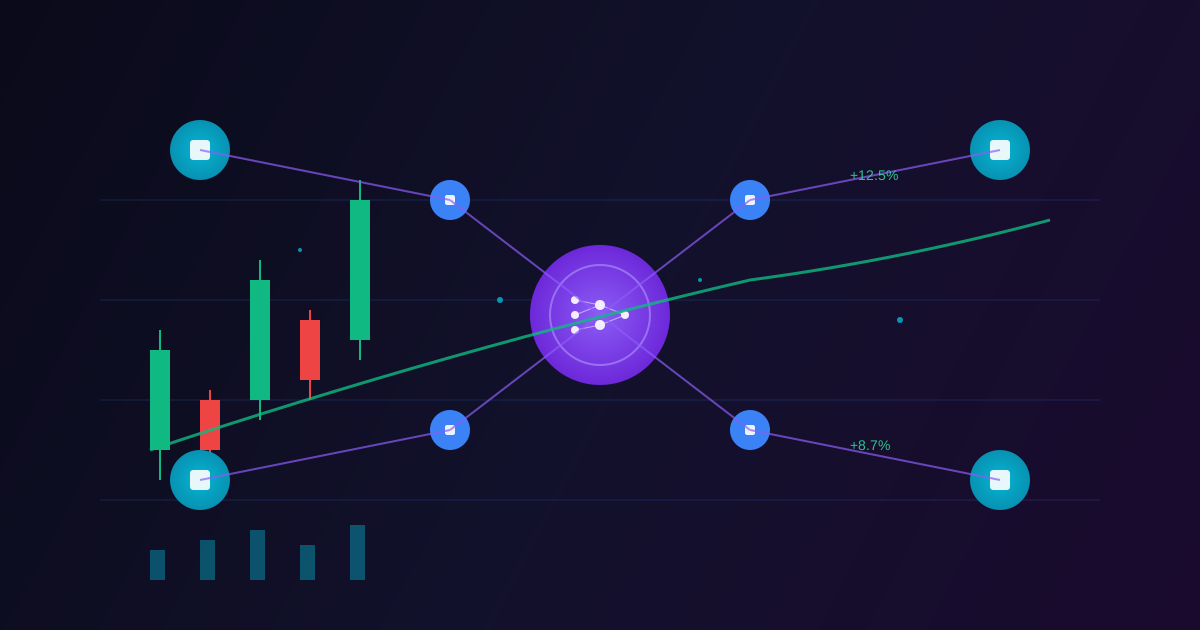
Complete tutorial for building profitable DeFi trading bots with Python, Web3.py, and risk management. Includes working code and compliance framework.
Contents
AI-Powered DeFi Trading Bots: Build Your First Automated Strategy in One Weekend
Decentralized finance markets never sleep. While you're eating dinner, sleeping, or stuck in meetings, price discrepancies appear and vanish across DEXs in seconds. Liquidity pools shift. Yield farming rates fluctuate. And the traders capturing these opportunities aren't refreshing dashboards manually — they're running AI-powered bots that execute strategies faster than any human could react.
The DeFi trading bot landscape has matured significantly in 2026. What used to require deep Solidity expertise and six-figure infrastructure budgets can now be built with Python, a few hundred dollars in cloud hosting, and a weekend of focused work. The combination of AI agent frameworks with DeFi protocols has created a new class of autonomous trading systems that can analyze market conditions, identify opportunities, and execute trades — all without human intervention.
In this guide, we'll walk through everything you need to build, test, and deploy your first AI-powered DeFi trading bot. We'll start with a basic arbitrage strategy, graduate to advanced liquidity provision, and cover the risk management and compliance frameworks that separate profitable bots from expensive experiments.
A word of caution: Trading cryptocurrency involves substantial risk. This content is for educational purposes. Never deploy trading capital you can't afford to lose, and always start with testnet deployments before touching mainnet funds.
Why Automate DeFi Trading Now
The Market Opportunity
DeFi's total value locked (TVL) crossed $180 billion in early 2026, up from $95 billion just 18 months ago. More importantly, the number of active DEXs has grown to over 400 across Ethereum, Arbitrum, Optimism, Base, Solana, and other chains. This fragmentation creates persistent pricing inefficiencies that automated systems can exploit.
Consider the numbers: on any given day, there are thousands of price discrepancies between Uniswap, SushiSwap, Curve, and Balancer pools. Most of these gaps exist for seconds or minutes before arbitrageurs close them. Manual traders can't compete with this speed — but a well-designed bot running on cloud infrastructure absolutely can.
The intersection of AI and DeFi has accelerated this opportunity. Modern AI models can process market signals that rule-based systems miss: social sentiment shifts, whale wallet movements, governance proposal impacts, and cross-chain liquidity flows. Bots that incorporate these signals consistently outperform purely technical strategies.
Human Limitations vs. Algorithmic Advantages
| Factor | Human Trader | AI Trading Bot |
|---|---|---|
| Reaction Time | 2-10 seconds | 50-200 milliseconds |
| Markets Monitored | 5-15 pairs | 500+ pairs simultaneously |
| Operating Hours | 8-16 hours/day | 24/7/365 |
| Emotional Bias | Significant | None |
| Consistency | Variable | Deterministic |
| Multi-Chain Execution | Impractical | Native capability |
The advantage isn't just speed — it's consistency. Human traders make different decisions based on fatigue, emotional state, and cognitive biases. A properly designed bot executes the same strategy identically whether it's 3 PM or 3 AM, whether the market is calm or in panic mode.
Current Inefficiencies Worth Exploiting
Cross-DEX Price Gaps: Price differences between major DEXs on the same chain average 0.1-0.5% for popular pairs. On less liquid pairs, gaps can reach 2-5%.
Cross-Chain Arbitrage: The same token priced differently on Ethereum mainnet vs. Layer 2s creates opportunities, especially around bridge delays and liquidity imbalances.
Liquidity Pool Imbalances: When large trades shift pool ratios, temporary pricing inefficiencies emerge that bots can capture through rebalancing.
Yield Farm Rotation: DeFi yield rates change constantly. Bots that automatically rotate between farms based on real-time APY calculations consistently outperform static strategies.
Architecture Overview: Building a Production-Ready Trading System
Before writing any code, let's establish the architecture that separates weekend experiments from production-grade trading systems. A well-structured DeFi bot has five distinct layers, each serving a critical function.
System Architecture
┌──────────────────────────────────────────────────┐
│                  AI Decision Layer                 │
│  (Market Analysis, Strategy Selection, Signals)   │
├──────────────────────────────────────────────────┤
│               Strategy Engine Layer               │
│  (Arbitrage, LP Management, Yield Farming)        │
├──────────────────────────────────────────────────┤
│              Risk Management Layer                │
│  (Position Limits, Circuit Breakers, Slippage)    │
├──────────────────────────────────────────────────┤
│              Execution Engine Layer               │
│  (Transaction Building, Gas Optimization, MEV)    │
├──────────────────────────────────────────────────┤
│             Infrastructure Layer                  │
│  (RPC Nodes, Monitoring, Alerting, Logging)       │
└──────────────────────────────────────────────────┘
Technical Stack
Core Language: Python 3.11+ — the ecosystem for both AI/ML libraries and Web3 development makes Python the clear choice.
Web3 Libraries:
web3.py— Ethereum and EVM chain interactionssolders/solana-py— Solana-specific interactionseth-abi— ABI encoding/decoding for direct contract calls
AI/ML Libraries:
langchainorcrewai— Agent orchestration for complex strategiesscikit-learn/xgboost— Price prediction and signal generationtransformers— Sentiment analysis from social and news feeds
Infrastructure:
- Alchemy or Infura for RPC endpoints
- Redis for caching and real-time state management
- PostgreSQL for trade history and analytics
- Grafana + Prometheus for monitoring dashboards
Risk Management:
- Custom circuit breaker implementations
- Position sizing via Kelly criterion
- MEV protection through Flashbots Protect or similar services
Infrastructure Decisions: Cloud vs. Local
Cloud Hosting (Recommended for Production):
- AWS EC2 or GCP Compute Engine in regions close to RPC endpoints
- Typical cost: $50-200/month for a bot monitoring 100+ pairs
- Benefits: reliability, low latency to major RPC providers, easy scaling
Local Hosting:
- Suitable for testing and small-scale operations
- Risk: internet outages, power failures, hardware issues
- Cost advantage disappears when you factor in reliability requirements
For production deployments, cloud hosting is non-negotiable. A missed trade due to a home internet outage can cost more than a year of cloud hosting.
Risk Management Layer
The risk management layer isn't optional — it's the single most important component of your system. Building secure AI systems for financial applications requires defense-in-depth:
Circuit Breakers:
- Maximum loss per trade: 2% of portfolio
- Maximum daily loss: 5% of portfolio
- Automatic shutdown on 3 consecutive losing trades
- Emergency kill switch accessible via API and manual override
Position Limits:
- Maximum position size: 10% of portfolio per trade
- Maximum exposure per token: 25% of portfolio
- Minimum liquidity requirements before entering positions
Slippage Protection:
- Maximum acceptable slippage: 0.5% for major pairs, 1% for minor pairs
- Pre-trade simulation to estimate actual execution price
- Automatic order cancellation if slippage exceeds thresholds
Tutorial: Building a Basic Arbitrage Bot
Let's build a working cross-DEX arbitrage bot that monitors price differences between Uniswap V3 and SushiSwap on Ethereum. This is the "Hello World" of DeFi trading bots — simple enough to understand in an afternoon, powerful enough to generate real profits.
Prerequisites
Development Environment:
# Create project directory and virtual environment
mkdir defi-arb-bot && cd defi-arb-bot
python -m venv venv
source venv/bin/activate

# Install dependencies
pip install web3 python-dotenv aiohttp redis asyncio
pip install eth-abi eth-utils
Environment Configuration:
# .env file
ETHEREUM_RPC_URL=https://eth-mainnet.g.alchemy.com/v2/YOUR_KEY
PRIVATE_KEY=your_wallet_private_key  # NEVER commit this
REDIS_URL=redis://localhost:6379
MIN_PROFIT_WEI=50000000000000000  # 0.05 ETH minimum profit
MAX_GAS_GWEI=30
Step 1: Price Feed Monitor
The foundation of any arbitrage bot is accurate, real-time price data from multiple sources.
import asyncio
from web3 import Web3
from decimal import Decimal
import json

# Uniswap V3 and SushiSwap router addresses
UNISWAP_V3_QUOTER = "0xb27308f9F90D607463bb33eA1BeBb41C27CE5AB6"
SUSHISWAP_ROUTER = "0xd9e1cE17f2641f24aE83637ab66a2cca9C378B9F"

# Common token addresses
WETH = "0xC02aaA39b223FE8D0A0e5C4F27eAD9083C756Cc2"
USDC = "0xA0b86991c6218b36c1d19D4a2e9Eb0cE3606eB48"
DAI = "0x6B175474E89094C44Da98b954EedeAC495271d0F"

class PriceMonitor:
    def __init__(self, w3: Web3):
        self.w3 = w3
        self.uniswap_quoter = w3.eth.contract(
            address=UNISWAP_V3_QUOTER,
            abi=self._load_abi("uniswap_v3_quoter")
        )
        self.sushiswap_router = w3.eth.contract(
            address=SUSHISWAP_ROUTER,
            abi=self._load_abi("sushiswap_router")
        )

    async def get_uniswap_price(self, token_in, token_out, amount_in, fee=3000):
        """Get quote from Uniswap V3 for a specific fee tier."""
        try:
            amount_out = self.uniswap_quoter.functions.quoteExactInputSingle(
                token_in, token_out, fee, amount_in, 0
            ).call()
            return amount_out
        except Exception as e:
            print(f"Uniswap quote error: {e}")
            return None

    async def get_sushiswap_price(self, token_in, token_out, amount_in):
        """Get quote from SushiSwap for the same pair."""
        try:
            amounts = self.sushiswap_router.functions.getAmountsOut(
                amount_in, [token_in, token_out]
            ).call()
            return amounts[-1]
        except Exception as e:
            print(f"SushiSwap quote error: {e}")
            return None

    async def find_arbitrage(self, token_a, token_b, amount):
        """Compare prices and identify arbitrage opportunities."""
        uni_price = await self.get_uniswap_price(token_a, token_b, amount)
        sushi_price = await self.get_sushiswap_price(token_a, token_b, amount)

        if uni_price is None or sushi_price is None:
            return None

        spread = abs(uni_price - sushi_price) / min(uni_price, sushi_price)

        return {
            "pair": f"{token_a[:8]}.../{token_b[:8]}...",
            "uniswap_out": uni_price,
            "sushiswap_out": sushi_price,
            "spread_pct": float(spread * 100),
            "profitable_direction": "uni_to_sushi" if uni_price > sushi_price else "sushi_to_uni",
            "gross_profit_wei": abs(uni_price - sushi_price)
        }

    def _load_abi(self, name):
        with open(f"abis/{name}.json") as f:
            return json.load(f)
Step 2: Profit Calculator with Gas Estimation
Finding a price difference isn't enough — you need to verify the opportunity is profitable after gas costs and slippage.
class ProfitCalculator:
    def __init__(self, w3: Web3, min_profit_wei: int):
        self.w3 = w3
        self.min_profit_wei = min_profit_wei

    async def calculate_net_profit(self, opportunity: dict) -> dict:
        """Calculate net profit after gas and slippage."""
        gross_profit = opportunity["gross_profit_wei"]

        # Estimate gas for the arbitrage transaction
        estimated_gas = 350_000  # Typical for a 2-swap arbitrage
        gas_price = self.w3.eth.gas_price
        gas_cost = estimated_gas * gas_price

        # Apply slippage estimate (0.3% for major pairs)
        slippage_cost = int(gross_profit * 0.003)

        net_profit = gross_profit - gas_cost - slippage_cost

        return {
            **opportunity,
            "gas_cost_wei": gas_cost,
            "gas_cost_eth": self.w3.from_wei(gas_cost, "ether"),
            "slippage_estimate_wei": slippage_cost,
            "net_profit_wei": net_profit,
            "net_profit_eth": self.w3.from_wei(max(0, net_profit), "ether"),
            "is_profitable": net_profit > self.min_profit_wei
        }
Step 3: Execution Engine
When a profitable opportunity is confirmed, the execution engine builds and submits the transaction with MEV protection.
class ExecutionEngine:
    def __init__(self, w3: Web3, private_key: str):
        self.w3 = w3
        self.account = w3.eth.account.from_key(private_key)

    async def execute_arbitrage(self, opportunity: dict) -> dict:
        """Execute the arbitrage trade with MEV protection."""
        if not opportunity.get("is_profitable"):
            return {"status": "skipped", "reason": "not profitable"}

        try:
            # Build the transaction based on direction
            if opportunity["profitable_direction"] == "uni_to_sushi":
                tx = await self._build_uni_to_sushi_tx(opportunity)
            else:
                tx = await self._build_sushi_to_uni_tx(opportunity)

            # Sign and send via Flashbots for MEV protection
            signed_tx = self.w3.eth.account.sign_transaction(
                tx, self.account.key
            )

            # Submit through Flashbots Protect RPC
            tx_hash = self.w3.eth.send_raw_transaction(
                signed_tx.raw_transaction
            )

            # Wait for confirmation
            receipt = self.w3.eth.wait_for_transaction_receipt(
                tx_hash, timeout=120
            )

            return {
                "status": "executed",
                "tx_hash": tx_hash.hex(),
                "gas_used": receipt["gasUsed"],
                "block_number": receipt["blockNumber"],
                "success": receipt["status"] == 1
            }

        except Exception as e:
            return {"status": "failed", "error": str(e)}

    async def _build_uni_to_sushi_tx(self, opportunity):
        """Build transaction: buy on SushiSwap, sell on Uniswap."""
        nonce = self.w3.eth.get_transaction_count(self.account.address)
        # Transaction building logic specific to your
        # arbitrage contract deployment
        return {
            "nonce": nonce,
            "gasPrice": self.w3.eth.gas_price,
            "gas": 400_000,
            "to": self.account.address,  # Your arbitrage contract
            "value": 0,
            "data": b"",  # Encoded contract call
        }
Step 4: Main Bot Loop
Tying it all together into a continuously running monitoring and execution loop:
import os
from dotenv import load_dotenv

load_dotenv()

async def main():
    w3 = Web3(Web3.HTTPProvider(os.getenv("ETHEREUM_RPC_URL")))
    monitor = PriceMonitor(w3)
    calculator = ProfitCalculator(
        w3, int(os.getenv("MIN_PROFIT_WEI"))
    )
    executor = ExecutionEngine(w3, os.getenv("PRIVATE_KEY"))

    # Token pairs to monitor
    pairs = [
        (WETH, USDC, w3.to_wei(1, "ether")),
        (WETH, DAI, w3.to_wei(1, "ether")),
        (USDC, DAI, 10_000 * 10**6),  # 10k USDC
    ]

    print("🤖 DeFi Arbitrage Bot Starting...")
    print(f"Monitoring {len(pairs)} pairs across Uniswap V3 and SushiSwap")

    while True:
        for token_in, token_out, amount in pairs:
            opportunity = await monitor.find_arbitrage(
                token_in, token_out, amount
            )
            if opportunity and opportunity["spread_pct"] > 0.1:
                result = await calculator.calculate_net_profit(opportunity)
                print(f"📊 {result['pair']}: {result['spread_pct']:.3f}% spread, "
                      f"net profit: {result['net_profit_eth']:.4f} ETH")

                if result["is_profitable"]:
                    print(f"🚀 Executing arbitrage...")
                    execution = await executor.execute_arbitrage(result)
                    print(f"Result: {execution['status']}")

        await asyncio.sleep(2)  # Poll every 2 seconds

if __name__ == "__main__":
    asyncio.run(main())
Testing on Testnet First
Never skip testnet testing. Deploy your bot on Ethereum Sepolia or Arbitrum Goerli first:
- Get testnet ETH from a faucet
- Deploy test tokens to simulate trading pairs
- Run the bot for at least 48 hours monitoring for bugs
- Verify all circuit breakers and kill switches function correctly
- Only move to mainnet after comprehensive testnet validation
Advanced Strategy: AI-Powered Liquidity Provision
Once you've mastered basic arbitrage, liquidity provision offers higher and more consistent returns — but with added complexity. The key challenge is impermanent loss, which can wipe out trading fee income if not managed properly.
Understanding Impermanent Loss
When you provide liquidity to a DEX pool, you deposit two tokens at a specific price ratio. As the price changes, the pool rebalances your position, and you end up with more of the depreciating token and less of the appreciating one. This "impermanent loss" is only realized when you withdraw, but it can be significant.
The Math: For a 50/50 pool, if the price of one token doubles relative to the other:
- Impermanent loss: ~5.7% compared to simply holding both tokens
- If the price 5x: impermanent loss reaches ~25.5%
AI-powered liquidity management mitigates this through dynamic position management and predictive analytics.
Dynamic Range Selection for Uniswap V3
Uniswap V3's concentrated liquidity allows you to specify price ranges for your positions. Narrower ranges earn higher fees but face more impermanent loss risk. An AI agent can optimize this tradeoff:
class LiquidityManager:
    def __init__(self, w3, ai_model, position_manager):
        self.w3 = w3
        self.ai_model = ai_model
        self.position_manager = position_manager

    async def optimize_position(self, pool_address, current_price):
        """Use AI to determine optimal liquidity range."""
        # Gather market signals
        volatility = await self._calculate_volatility(pool_address, hours=24)
        volume_trend = await self._get_volume_trend(pool_address)
        sentiment = await self.ai_model.analyze_market_sentiment()

        # AI predicts price range for next 24 hours
        predicted_range = await self.ai_model.predict_price_range(
            current_price=current_price,
            volatility=volatility,
            volume_trend=volume_trend,
            sentiment=sentiment,
            confidence_level=0.85  # 85% confidence interval
        )

        # Calculate optimal tick range
        lower_tick = self._price_to_tick(predicted_range["low"])
        upper_tick = self._price_to_tick(predicted_range["high"])

        # Estimate fee earnings vs impermanent loss
        expected_fees = await self._estimate_fee_income(
            pool_address, lower_tick, upper_tick
        )
        expected_il = self._estimate_impermanent_loss(
            current_price, predicted_range
        )

        return {
            "lower_tick": lower_tick,
            "upper_tick": upper_tick,
            "expected_daily_fees": expected_fees,
            "expected_daily_il": expected_il,
            "net_expected_return": expected_fees - expected_il,
            "rebalance_trigger": predicted_range["rebalance_price"]
        }

    async def auto_rebalance(self, position_id):
        """Monitor and rebalance position when price exits range."""
        position = await self.position_manager.get_position(position_id)
        current_price = await self._get_current_price(position["pool"])

        if current_price < position["lower_price"] * 0.98 or \
           current_price > position["upper_price"] * 1.02:
            # Price has moved outside our range — rebalance
            print(f"⚡ Rebalancing position {position_id}")
            await self.position_manager.withdraw(position_id)
            new_params = await self.optimize_position(
                position["pool"], current_price
            )
            await self.position_manager.deposit(
                position["pool"], new_params
            )
Multi-Pool Diversification
Don't concentrate liquidity in a single pool. A robust strategy distributes across multiple pools with different risk profiles:
High-Fee Pools (1% fee tier): Volatile pairs like ETH/altcoins — higher impermanent loss risk but higher fee income.
Medium-Fee Pools (0.3% fee tier): Standard pairs like ETH/USDC — balanced risk/reward profile for the core of your portfolio.
Low-Fee Pools (0.05% fee tier): Stable pairs like USDC/DAI — minimal impermanent loss, steady but lower returns.
A well-diversified liquidity portfolio allocates approximately 20% to high-fee pools, 50% to medium-fee pools, and 30% to low-fee pools, adjusted based on market conditions.
Yield Farming Integration
Beyond trading fees, many liquidity positions qualify for additional yield farming rewards. An AI agent can automatically:
- Monitor reward rates across protocols and chains
- Claim rewards at optimal intervals (balancing gas costs vs. compounding benefits)
- Reinvest earnings into highest-yielding positions
- Migrate liquidity when better opportunities emerge
The combination of trading fee optimization, impermanent loss mitigation, and automated yield farming creates a compounding return engine that significantly outperforms static liquidity provision.
Risk Management and Backtesting
Risk management is what separates profitable bots from expensive lessons. The strategies in this section aren't optional — they're essential for survival in DeFi markets.
Position Sizing with Kelly Criterion
The Kelly criterion calculates optimal position sizes based on your edge and win rate:
def kelly_position_size(win_rate, avg_win, avg_loss, bankroll):
    """Calculate optimal position size using Kelly criterion."""
    # Kelly formula: f* = (bp - q) / b
    # where b = avg_win/avg_loss, p = win_rate, q = 1 - win_rate
    b = avg_win / avg_loss
    p = win_rate
    q = 1 - p

    kelly_fraction = (b * p - q) / b

    # Use fractional Kelly (25-50%) for safety
    conservative_fraction = kelly_fraction * 0.25
    position_size = bankroll * max(0, conservative_fraction)

    return {
        "full_kelly": kelly_fraction,
        "conservative_kelly": conservative_fraction,
        "position_size": position_size,
        "max_risk": position_size * avg_loss
    }
Important: Always use fractional Kelly (25-50% of the full Kelly value). Full Kelly sizing is mathematically optimal but assumes perfect knowledge of your edge — which you never have in practice.
Historical Backtesting
Before deploying any strategy with real capital, backtest against historical data:
class Backtester:
    def __init__(self, historical_data, strategy, initial_capital):
        self.data = historical_data
        self.strategy = strategy
        self.capital = initial_capital
        self.trades = []

    def run(self):
        """Execute strategy against historical data."""
        for timestamp, market_state in self.data.iterrows():
            signal = self.strategy.evaluate(market_state)

            if signal and signal["action"] == "trade":
                result = self._simulate_trade(signal, market_state)
                self.trades.append(result)
                self.capital += result["pnl"]

        return self._generate_report()

    def _generate_report(self):
        wins = [t for t in self.trades if t["pnl"] > 0]
        losses = [t for t in self.trades if t["pnl"] <= 0]
        return {
            "total_trades": len(self.trades),
            "win_rate": len(wins) / max(1, len(self.trades)),
            "total_pnl": sum(t["pnl"] for t in self.trades),
            "max_drawdown": self._calculate_max_drawdown(),
            "sharpe_ratio": self._calculate_sharpe_ratio(),
            "avg_win": sum(t["pnl"] for t in wins) / max(1, len(wins)),
            "avg_loss": sum(t["pnl"] for t in losses) / max(1, len(losses)),
        }
Backtesting Rules:
- Use at least 6 months of historical data
- Include at least one major market crash period
- Account for gas costs, slippage, and MEV at historical rates
- Don't over-optimize — strategies that look perfect in backtests often fail live
Slippage and MEV Protection
Slippage Protection: Always set maximum slippage tolerances on trades. For arbitrage, the window is tight — even 0.5% unexpected slippage can turn a profitable trade into a loss.
MEV Protection Strategies:
- Flashbots Protect: Route transactions through Flashbots to avoid frontrunning
- Private Mempools: Use services like MEV Blocker or Flashbots Protect RPC
- Batch Transactions: Bundle multiple operations into single atomic transactions
- Commit-Reveal Schemes: For larger trades, use two-step execution to hide intent
# Example: Sending transaction via Flashbots Protect
FLASHBOTS_RPC = "https://rpc.flashbots.net"

def send_protected_transaction(w3, signed_tx):
    """Route transaction through Flashbots to prevent MEV extraction."""
    flashbots_w3 = Web3(Web3.HTTPProvider(FLASHBOTS_RPC))
    tx_hash = flashbots_w3.eth.send_raw_transaction(
        signed_tx.raw_transaction
    )
    return tx_hash
Emergency Protocols and Circuit Breakers
class CircuitBreaker:
    def __init__(self, max_daily_loss_pct=5.0, max_consecutive_losses=3):
        self.max_daily_loss_pct = max_daily_loss_pct
        self.max_consecutive_losses = max_consecutive_losses
        self.daily_pnl = 0
        self.consecutive_losses = 0
        self.is_active = True

    def record_trade(self, pnl, portfolio_value):
        self.daily_pnl += pnl

        if pnl < 0:
            self.consecutive_losses += 1
        else:
            self.consecutive_losses = 0

        daily_loss_pct = abs(min(0, self.daily_pnl)) / portfolio_value * 100

        if daily_loss_pct >= self.max_daily_loss_pct:
            self.is_active = False
            self._alert("🚨 CIRCUIT BREAKER: Daily loss limit reached")

        if self.consecutive_losses >= self.max_consecutive_losses:
            self.is_active = False
            self._alert("🚨 CIRCUIT BREAKER: Consecutive loss limit reached")

    def can_trade(self):
        return self.is_active

    def _alert(self, message):
        # Send alerts via Discord/Telegram/email
        print(message)
Legal and Compliance Framework
Automated DeFi trading exists in a complex and evolving regulatory landscape. Ignoring compliance doesn't make it go away — it just makes the consequences worse when regulators come knocking.
Regulatory Landscape by Jurisdiction
United States: The SEC and CFTC have increased scrutiny of automated trading in digital assets. Key considerations include securities classification of tokens traded, money transmission laws, and wash trading prohibitions.
European Union: MiCA (Markets in Crypto-Assets) regulation, fully effective since 2025, requires registration for certain automated trading activities. Algorithmic trading provisions similar to MiFID II increasingly apply to crypto markets.
Asia-Pacific: Regulations vary significantly. Singapore and Japan have relatively clear frameworks, while other jurisdictions remain ambiguous. Research your specific jurisdiction before deploying.
KYC/AML Implications
Automated trading doesn't exempt you from Know Your Customer (KYC) and Anti-Money Laundering (AML) requirements. Key considerations:
- Exchange Interactions: Any interaction with centralized exchanges requires KYC compliance
- Large Transaction Reporting: Automated systems may trigger suspicious activity reporting thresholds
- Cross-Border Transactions: Multi-chain arbitrage may involve cross-border implications
- Record Keeping: Maintain complete records of all automated trading activity
Tax Considerations
Every trade your bot executes is a taxable event in most jurisdictions. This means:
- Comprehensive Trade Logging: Record every transaction with timestamp, amounts, prices, and fees
- Cost Basis Tracking: Maintain FIFO, LIFO, or specific identification records
- Automated Reporting: Generate tax-ready reports from your trade logs
- Professional Consultation: Work with a crypto-specialized tax professional
The combination of AI agent transparency requirements and blockchain audit trails can actually simplify compliance. Every trade on-chain is permanently recorded, making audit trail creation straightforward compared to traditional trading.
Essential Disclaimers
Include in all bot documentation and communications:
- Past performance does not guarantee future results
- Cryptocurrency trading involves substantial risk of loss
- Automated trading systems can malfunction or execute unintended trades
- Users are responsible for understanding and complying with applicable regulations
- This software is provided for educational purposes — use at your own risk
Deployment and Monitoring
Cloud Deployment Setup
For production deployment, a minimal AWS setup looks like:
# EC2 instance setup (Ubuntu 22.04, t3.medium)
sudo apt update && sudo apt upgrade -y
sudo apt install python3.11 python3.11-venv redis-server -y

# Clone and configure
git clone https://github.com/your-repo/defi-bot.git
cd defi-bot
python3.11 -m venv venv
source venv/bin/activate
pip install -r requirements.txt

# Configure environment
cp .env.example .env
nano .env  # Add your RPC URLs, keys, and parameters

# Run with systemd for auto-restart
sudo cp defi-bot.service /etc/systemd/system/
sudo systemctl enable defi-bot
sudo systemctl start defi-bot
Systemd Service File:
[Unit]
Description=DeFi Trading Bot
After=network.target redis.target

[Service]
Type=simple
User=ubuntu
WorkingDirectory=/home/ubuntu/defi-bot
ExecStart=/home/ubuntu/defi-bot/venv/bin/python main.py
Restart=always
RestartSec=10
Environment=PYTHONUNBUFFERED=1

[Install]
WantedBy=multi-user.target
Real-Time Monitoring Dashboard
Track your bot's performance with key metrics:
Essential Metrics:
- P&L (rolling 24h, 7d, 30d) — Is the bot making money?
- Trade count and win rate — Is the strategy executing as expected?
- Gas costs — Are execution costs eating into profits?
- Slippage — Are trades executing at expected prices?
- Uptime — Is the bot running reliably?
Alerting Rules:
- Daily P&L exceeds -3%: Warning notification
- Daily P&L exceeds -5%: Critical alert + auto-shutdown
- Bot offline for >5 minutes: Immediate alert
- Gas prices spike above threshold: Pause trading
- Unusual transaction patterns detected: Alert for manual review
Emergency Shutdown
Every production bot needs a kill switch accessible through multiple channels:
class KillSwitch:
    def __init__(self, redis_client):
        self.redis = redis_client
        self.KILL_KEY = "bot:kill_switch"

    def activate(self, reason="manual"):
        """Immediately stop all trading activity."""
        self.redis.set(self.KILL_KEY, reason)
        self._close_open_positions()
        self._send_alert(f"🛑 Kill switch activated: {reason}")

    def is_active(self):
        return self.redis.exists(self.KILL_KEY)

    def deactivate(self):
        self.redis.delete(self.KILL_KEY)
        self._send_alert("✅ Kill switch deactivated, trading resumed")
Kill switch access points:
- API endpoint (authenticated)
- Discord/Telegram bot command
- Redis key set (for automated circuit breakers)
- AWS Systems Manager for remote SSH-free access
Ongoing Maintenance
DeFi protocols evolve constantly. Your bot needs regular maintenance:
- Weekly: Review performance metrics and optimize parameters
- Bi-weekly: Update dependencies and check for security patches
- Monthly: Re-run backtests with recent data to validate strategy performance
- As needed: Update contract ABIs when protocols upgrade, adapt to new fee structures, respond to market regime changes
The most successful trading bot operators treat their bots like production software systems — with continuous monitoring, regular updates, and proactive maintenance schedules.
Frequently Asked Questions
How much capital do I need to start running a DeFi trading bot?
For basic arbitrage on Ethereum mainnet, you'll need $5,000-10,000 minimum to cover gas costs and generate meaningful profits. On Layer 2 networks like Arbitrum or Base, you can start with $1,000-3,000 due to significantly lower gas costs. For liquidity provision strategies, $10,000+ is recommended to diversify across multiple pools. Always start with testnet deployment and only use capital you can afford to lose entirely.
What are the realistic returns for a DeFi arbitrage bot?
Returns vary significantly based on market conditions, competition, and strategy sophistication. Realistic expectations for a well-optimized bot: 5-15% monthly during high-volatility periods, 1-5% monthly during calm markets, with occasional losing months. Claims of 50%+ monthly returns are almost always misleading. The most successful operators focus on consistency over maximum returns.
How do I protect my bot from MEV attacks and frontrunning?
Use Flashbots Protect or similar private mempool services to prevent your transactions from being visible to MEV searchers. Implement slippage limits on all trades. For larger positions, use commit-reveal schemes or batch auctions through protocols like CowSwap. Consider deploying on Layer 2 networks where MEV extraction is less prevalent than on Ethereum mainnet.
Can I run a trading bot legally?
Automated trading is generally legal in most jurisdictions, but specific regulations vary. Key requirements include: compliance with applicable securities laws, KYC/AML obligations when interacting with regulated entities, comprehensive record-keeping for tax purposes, and potentially registering as a money services business depending on your jurisdiction and scale. Always consult with a crypto-specialized attorney in your jurisdiction before deploying trading capital.
What happens if my bot makes a bad trade or encounters a bug?
Circuit breakers and position limits are your primary defense. Properly implemented risk management will automatically stop trading when losses exceed predefined thresholds. Emergency kill switches provide manual override capability. The key is testing extensively on testnet before mainnet deployment and starting with small positions while monitoring closely. Even well-tested bots can encounter unexpected situations — your risk management framework determines whether a bug costs you 2% or 100% of your portfolio.
How do DeFi trading bots compare to traditional algorithmic trading?
DeFi trading bots share core principles with traditional algo trading but differ in important ways. Advantages: lower barriers to entry, 24/7 markets, transparent order books (AMM pools), programmable money via smart contracts. Disadvantages: higher execution risks (smart contract bugs, oracle failures), less regulatory clarity, higher slippage on large orders, and MEV extraction that doesn't exist in traditional markets. Many successful DeFi bot operators have backgrounds in traditional finance but adapted their strategies for the unique characteristics of decentralized markets.
Conclusion: From Tutorial to Trading
Building an AI-powered DeFi trading bot is no longer reserved for quantitative hedge funds with million-dollar budgets. The combination of mature AI development frameworks, accessible DeFi infrastructure, and proven strategy patterns means anyone with Python skills and a disciplined approach can build automated trading systems.
Here's your roadmap from this tutorial to production:
Weekend 1: Foundation
- Set up your development environment
- Deploy the basic arbitrage bot on testnet
- Monitor for 48+ hours and fix issues
Weekend 2: Enhancement
- Add risk management and circuit breakers
- Implement the profit calculator with gas estimation
- Begin historical backtesting
Week 3-4: Optimization
- Integrate AI-powered market analysis
- Add liquidity provision strategies
- Implement comprehensive monitoring and alerting
Month 2: Production
- Deploy to cloud infrastructure with small capital
- Monitor closely with conservative position limits
- Gradually increase position sizes as confidence builds
The most important lesson from every successful bot operator: start small, iterate fast, and never skip risk management. The DeFi markets will be here tomorrow. There's no rush to deploy capital before your system is thoroughly tested and your risk management is bulletproof.
The intersection of AI agents and blockchain technology is creating unprecedented opportunities in automated finance. Whether you're building a simple arbitrage bot or a sophisticated multi-strategy trading system, the principles in this guide will serve as your foundation.
Ready to start building? Clone the companion GitHub repository for complete working code, additional strategy examples, and a pre-configured testing environment. Join our community Discord to connect with other DeFi bot builders and share strategies.
Disclaimer: This article is for educational purposes only. Trading cryptocurrency involves substantial risk of loss. Past performance does not guarantee future results. Always conduct your own research and consult with qualified financial and legal professionals before deploying trading capital.